
The Teleférico do Alemão
More than a cable car — a symbol of hope, politics and the challenges of urban mobility.
A cable car between mobility, urban development, symbolic politics and the daily life of thousands of residents.
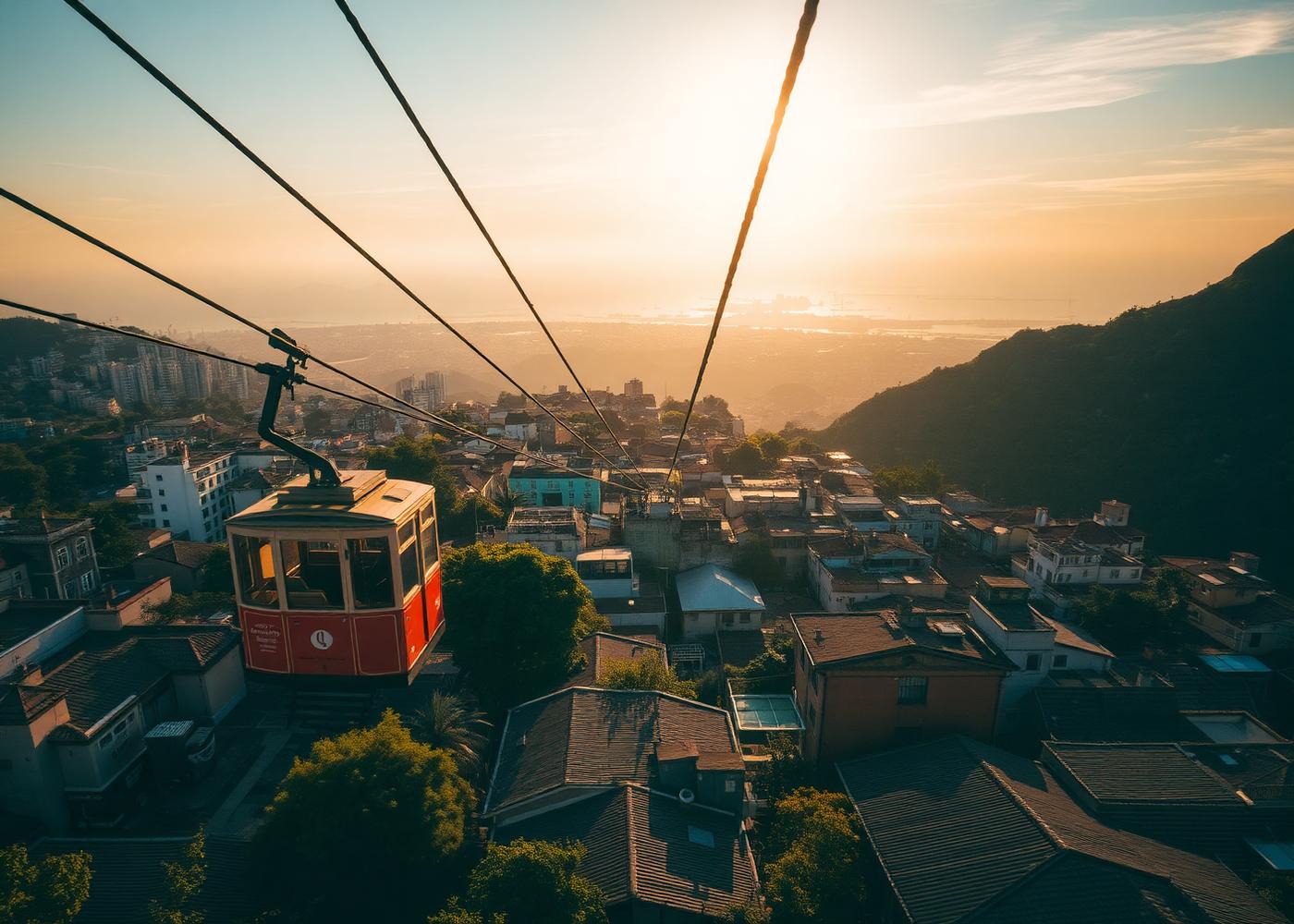
Early in the morning, the paths in the Complexo do Alemão lead downwards. A resident closes their front door, walks through a narrow alley and descends stairs to a station. Before the cable car opened, the first leg of a journey could already account for a substantial part of the commute: on foot to the nearest driveable street, then onward by van, bus or motorcycle taxi, then to the train. With the Teleférico, several unpredictable stages became, for some passengers, a comparatively clear connection to Bonsucesso.
This scene is typical but not universal. The Complexo do Alemão consists of several communities across hills and valleys. Not every front door lay close to a station, not every destination lay via Bonsucesso, and not everyone could use the access points equally well. The cable car's benefit therefore never started abstractly with a technical capacity, but with the distance between home, station and destination.
For many, the system nonetheless meant something very concrete: less climbing, a more predictable interchange to SuperVia, better access to work, school, shopping or healthcare. At the same time, it became a visible symbol of an era in which Rio invested billions in major projects, security programmes and preparations for the football World Cup and the Olympic Games. It is precisely this dual role that makes a simple verdict impossible.
The Teleférico was both a means of transport and a political image, an engineering achievement and a contested priority, an everyday help and, later, an example of what happens when operation and maintenance are not secured as durably as construction. Anyone wanting to understand its history must therefore look at cabins and haul ropes just as much as at budgets, police policy, local routes and the voices of the people beneath the line.
What is the Teleférico do Alemão?
The Teleférico do Alemão is an urban cable car system in the Complexo do Alemão, a cluster of communities in Rio de Janeiro's Zona Norte. Unlike a touristic mountain railway, it was designed as part of the public transport network. Its central purpose was to connect densely built, elevated residential areas via several intermediate stations to Bonsucesso, and from there to the SuperVia suburban railway.
The original line was around 3.5 kilometres long. Frequently documented planning and operating figures cite six stations, 152 cabins with room for up to ten people each, and a total journey time of roughly 16 minutes. Such figures are useful, but must be labelled carefully: a theoretical capacity is not the same as the number of people actually carried, and a historical fleet size says nothing about the current condition of individual cabins.
Technically, this was a detachable gondola lift: cabins move continuously along the haul rope, are then decoupled and slowed down in the stations so passengers can board and alight. This principle allows a steady flow of passengers without every cabin having to stop together with all the others.
Not to scale. Verify official designations before publication.
- BonsucessoGateway to the urban rail network
- AdeusFirst station on the hillside
- BaianaA hub within the Complexo
- AlemãoElevated interchange point
- ItararéAccess to further hillside areas
- PalmeirasTerminus of the original line
Why was the cable car built?
The underlying planning question was easy to grasp: how do you provide access to a densely built, steep area where new wide roads would require massive interventions in homes and neighbourhoods? A cable car needs stations and pylons but flies over much of the space in between. For topographically difficult neighbourhoods, it can therefore be a powerful complement.
In the Complexo, this technical argument coincided with a political moment. From 2007, the Programa de Aceleração do Crescimento, or PAC, provided substantial funding for infrastructure. Rio was simultaneously preparing for major international events. The city and the state wanted to show that areas neglected for decades were being connected to public networks. Roads, housing, public spaces and transport were often conceived together with security measures.
At the same time, the era of the UPPs, the Unidades de Polícia Pacificadora, began. The programme was meant to strengthen a permanent state presence in selected favelas and push back armed groups. In the Complexo do Alemão, a major police operation in late 2010 was followed by a new security architecture and the opening of the cable car in 2011. This chronological proximity shaped how the project was perceived: infrastructure was presented as a visible part of a policy linking security, social integration and international image-building.
A nuanced assessment separates these layers without artificially detaching them from one another. The need for mobility was real. So was the political staging. Criticism focused, among other things, on whether expensive, highly visible flagship projects should take priority over sewage systems, schools, healthcare or small-scale local access. Supporters pointed to the daily time savings and to the argument that residents of peripheral neighbourhoods have a right to ambitious public infrastructure.
„A project can be useful, contested and politically staged all at once. It is precisely this simultaneity that belongs to the story of the Teleférico."
Planning and construction above a built city
Building a cable car above a densely populated area differs fundamentally from building one on an unbuilt mountainside. Surveying, foundations and assembly had to take place in a space where people lived, ran businesses and moved along narrow paths. Pylons required load-bearing sites; stations needed larger plots, technical areas, access points and escape routes.
The engineering design had to account for route height, cable sag, wind, distances to buildings and the loads on the pylons. At the same time, construction was a social intervention. Where land was needed for stations or access points, homes could be affected. A serious account must therefore not describe only construction time and engineering, but must also include compensation, resettlement and the question of who had a say over the route.
Surveying and route selection
Topography, built-up areas, safety clearances and station locations are brought together.
Land and foundations
Plots are secured; deep foundations absorb the high tension and wind loads.
Pylons and stations
Support structures, platforms, drive units, return stations and access points are built in several construction phases.
Cable installation and cabins
Cables are pulled through, roller batteries are aligned, and cabins are introduced into the system.
Testing and commissioning
Brakes, evacuation, communication and operation under load are tested.
Different figures circulate regarding costs, and they do not always cover the same items: pure cable car technology, stations, surrounding works, expropriations, or parts of a larger PAC package. Without a consistent price basis, a single figure easily misleads. This article therefore does not state a falsely precise total sum, but refers instead to contracts, audit reports and inflation-adjusted benchmarks for any cost analysis.
The stations and their surroundings
Stations are not neutral stopping points on urban cable cars. They change routes, concentrate people and create new interfaces between public transport and neighbourhood. Their benefit depends on how easily they can be reached on foot, whether lifts are working, and how safe, lively and accessible the surrounding area is.
Bonsucesso
Gateway to the urban rail network
The valley station provided the crucial connection to SuperVia. For passengers from the Complexo it was not merely the start or end of the cable car, but the interchange point towards the city centre and other parts of the metropolitan region. This link is precisely what turned an isolated aerial ropeway into one part of a longer daily chain.
Adeus
First station on the hillside
Adeus opened up residential areas whose routes had previously been dominated by stairs, steep streets and informal transport. The concrete effect, however, depended on where someone lived: those close to the station often gained a lot of time, while those who still had to walk a long way through alleys experienced a smaller benefit.
Baiana
A hub within the Complexo
Baiana lay not only on the route but within a dense social and economic environment. New pedestrian flows formed around stations. These could bring custom to small businesses, but also shifted existing routes, making the project's impact highly localised.
Alemão
Elevated interchange point
This station became particularly closely associated with the image of the Teleférico. Its location opened up sweeping views across the Zona Norte and drew media and tourist attention. For the neighbourhood it simultaneously remained everyday infrastructure — a tension between residence, public transport and external visibility.
Itararé
Access to further hillside areas
Itararé opened up further densely populated hillside areas and, thanks to its view over the Zona Norte, also became publicly visible. As at the other stations, the practical benefit still depended on how far away the home was and how well the access paths worked.
Palmeiras
Terminus of the original line
Palmeiras formed the end point of the route. For residents of the upper and more remote areas the station was especially relevant, because without the cable car the journey to the rail connection in Bonsucesso could involve several stages. Here too the same held true: the last mile between the front door and the station determined the actual benefit.
How the cable car could change everyday life
Mobility is often measured in kilometres. For residents of a morro, elevation matters at least as much. A route of 800 metres can consist of long stairs, uneven stretches and several interchanges. The cable car overcame part of this barrier and turned vertical distance into a predictable ride.
For commutes, the connection to Bonsucesso was central. From there, trains ran towards the city centre and other transport hubs. A regular, traffic-independent leg could stabilise the entire journey chain. What mattered, however, was the quality of the connection: if the train was cancelled, the lift was broken, or the home lay far from the station, the benefit shrank.
School journeys and healthcare access revealed a different dimension. Children, older people, pregnant women or people with limited mobility experience gradients differently from young adults. A cable car can physically ease routes, but it is not automatically fully accessible. Access to the station, functioning lifts, sufficiently wide paths and trained staff are all part of the system.
- Front doorAlleys and stairs
- StationAccess and waiting time
- TeleféricoRide across the hillside
- BonsucessoInterchange with SuperVia
- DestinationWork, school, services
Shopping trips changed too. Someone transporting large or heavy purchases values a saved climb differently from someone carrying light luggage. At the same time, cabin size, access routes and operating hours remained real constraints. The Teleférico was therefore never a substitute for the entire local mobility ecosystem, but a new building block alongside vans, buses, motorcycle taxis and footpaths.
What the Teleférico meant for the Zona Norte
The Zona Norte is often overlooked in international images of Rio. While the beaches and mountains of the Zona Sul dominate the touristic imagination, the north contains large residential areas, industrial sites, universities, stadiums, rail lines and a substantial part of the metropolis's daily life. The Teleférico visibly brought a slice of this region into the debate on modern infrastructure.
Its most important spatial achievement was linking two networks: above, a fine-grained system of alleys and local transport options; below, the large-scale rail corridor. This could expand the reachable job market — at least for people whose routes sensibly ran via Bonsucesso. Accessibility matters economically, because it determines which jobs, schools, markets and services are reachable within a reasonable time.
New customer flows could emerge around the stations. Bars, small shops, service providers and informal trade responded to changing routes. Such effects, however, are not automatically distributed positively. A business on a previously well-used van route could lose customers while a stall at a station entrance gained them. Without long-term local data, one should claim neither an economic boom nor irrelevance.
Visibility also had two sides. Media images of the gondolas above the houses made the Complexo known worldwide and challenged the idea that high-quality transport technology belongs only in wealthy neighbourhoods. At the same time, some reports reduced the region to a panorama, a police operation or a prestige project. Being visible does not automatically mean being seen with nuance.
Architecture, haul ropes and maintenance
The heart of a gondola lift lies not in the cabin, but in the interplay between cable, grips, rollers, drive, brakes and control systems. Along the open route, cabins are carried and moved by the cable. In the stations, automatic grips release the cabin from the fast-moving cable so it travels more slowly through the boarding area. It then re-couples.
Pylons transfer considerable forces into the ground. Roller batteries guide the cable and must be precisely aligned. Stations house the drive unit or return mechanism; tensioning systems compensate for length changes caused by temperature and load. Wind monitoring, communication, emergency drive systems and multiple layers of brakes are all part of operational safety.
Cabin and grip
Transport; automatic coupling and decoupling at stations
Cable and rollers
Carrying, moving and precisely guiding along the route
Pylons and foundations
Transfer dead weight, cable tension, payload and wind loads
Drive and brakes
Regular operation, controlled stopping and redundant safety
Maintenance is not a downstream cost item but part of the design itself. Cables are inspected visually and with specialised methods, grips are disassembled, roller bearings are checked, brakes are tested, and wearing parts are replaced on fixed cycles. Add to that buildings, lifts, power supply and digital controls. A system can be opened to technical acclaim and still fail if this work is not durably funded and organised.
Residents' views were never uniform
Large projects easily generate two oversimplified narratives. In the first, the state brings progress and the population is grateful. In the second, all infrastructure is mere staging and is rejected outright. Both strip residents of their diversity. In the Complexo, assessments depended on where someone lived, their occupation, age, physical mobility, proximity to a station, and their experiences during construction.
Someone who climbed long stairs daily and then had to travel to Bonsucesso could experience the cable car as a tangible improvement. Someone who lived outside the catchment area may have seen an expensive system pass over their roof while sewage or paved streets were still missing. Traders assessed new flows differently from families whose homes had to make way for construction. Young people could take pride in the technical modernity; others were bothered by visitors' cameras pointed at private rooftop terraces.
Assessments also changed over time. A system can be contested during planning, practical in operation, and missed after its closure. Conversely, initial enthusiasm can fade as lifts break down, waiting times rise, or political promises go unfulfilled. Any journalistic account must allow for such shifts over time.
The closure and its consequences
In September 2016, operations ended. The closure fell during a severe financial crisis in the state of Rio de Janeiro, shortly after the Olympic Games. Reports cited outstanding, or unsecured, operating funds and considerable maintenance needs. As is often the case with complex public projects, the end cannot be reduced to a single defective component or a single political decision.
For regular users, the consequence was immediate: the fast vertical connection and the direct interchange to the railway disappeared. Alternative routes existed, but they were not equivalent. Buses and vans move through road traffic, motorcycle taxis are not suitable for everyone, and footpaths on the hillside cost energy and time. For people with limited mobility in particular, the loss could be severe.
For the public debate, the stationary system became the counter-image to the opening-day photographs. The cabins and stations remained widely visible, but the benefit was no longer available. This shifted the question: no longer simply whether the original investment had been right, but why such a large system had been built without a robust model for operation, maintenance and renewal.
Closure also incurs its own costs. Systems must be secured, preserved and monitored even while idle. The longer systems stand still, the greater the risks of corrosion, vandalism, ageing electronic components, and difficulty sourcing spare parts. A later refurbishment is therefore not simply a matter of switching an existing system back on.
Reactivation: distinguishing announcement, construction site and operation
Since the closure, a resumption has been politically announced multiple times. Named dates shifted from 2023 to 2024, 2025 and the second half of 2026. Recent press reports now name June 2027 as the new target. This sequence is itself part of the project's story. Such reports need to be read precisely: the release of a budget is not yet construction progress, a test run is not yet public operation, and the opening of individual stations does not necessarily mean the full original line is back in service.
A technical reactivation involves far more than a fresh coat of paint. Cables and grips, rollers, drive units, brakes, controls, power supply, communication, cabins, lifts and station buildings must all be inspected, repaired or replaced. There is also commissioning, test runs, evacuation drills, staff training and the question of who pays for operation and ongoing maintenance.
For residents, what ultimately matters is not the announcement but reliability: which stations are open? At what times? How is the fare structured? Do the lifts work? How does the interchange work? What happens if there is a fault? A relaunch can only build trust if this information is transparent and the service remains stable over time.
Tourism was a side role — with real consequences
The view from the cabin was extraordinary. Visitors saw the Zona Norte from a perspective rarely offered by touristic routes, and the media often made use of the panorama. This made the cable car interesting for travellers too. This attention, however, did not retroactively turn it into a tourist attraction in the strict sense: its basic purpose was public transport.
The distinction matters ethically. Someone using an everyday line is not entering a theme park. Beneath the cabins lie homes, rooftop terraces, schools and private spaces. A telephoto lens can intrude into people's everyday lives from a great distance. Respect means photographing people only with their consent, not capturing sensitive situations, and not staging the visit as an expedition into a supposedly foreign place.
If the system is running publicly, official access and operating rules apply. The current local situation should also be checked. A guide from the community can explain the historical and social context, but does not replace either official operating information or an up-to-date safety assessment. Our detailed safety guide to Rio's favelas explains how to combine sources.
Medellín, La Paz and Rio: similar technology, different systems
Medellín is regarded as the most important reference example for urban cable cars in Latin America. The Metrocable was integrated into the metro and bus system and linked with public spaces, libraries and neighbourhood projects. Its success made cable cars a global tool of urban planning. Rio drew on this idea but transferred it into a different institutional and political environment.
La Paz and El Alto went further still. Mi Teleférico is a network of several lines connecting large parts of two cities. This creates interchange options and a network effect that a single line cannot offer. The scale is so different that league tables convey little: a local feeder line and a regional network serve different purposes.
| System | Role in the network | Urban policy context | Lesson |
|---|---|---|---|
| Complexo do Alemão, Rio | Local feeder to SuperVia | PAC, UPP era, major events | Lasting operation must be institutionally secured from the construction stage onward. |
| Metrocable, Medellín | Several feeders into an integrated metro network | Long-term integrated urban development | Transport has more impact when paired with reliable connections and neighbourhood investment. |
| Mi Teleférico, La Paz / El Alto | Large network with several lines | Metropolitan primary transport infrastructure | Network effects and frequent interchanges fundamentally change the benefit. |
The comparison shows no winner. It shows conditions: integration with other means of transport, long-term funding, reliable maintenance, good access, and planning that works with residents rather than merely over them. The same technology can produce very different results under different conditions.
Myths and reality
Myth: "The cable car was only for tourists."
Reality: It was planned as a public transport system and used by residents for everyday journeys. Tourist attention was real, but it does not describe its sole or most important function.
Myth: "All residents wanted the Teleférico."
Reality: Attitudes varied. Some benefited directly, others lived far from stations, criticised the project's priorities, or were affected by construction work.
Myth: "All residents rejected the project."
Reality: This is also false. Time savings, easier access and the connection to SuperVia had real value for many.
Myth: "The cable car solved the Complexo's transport problems."
Reality: It complemented the transport network, but it did not replace buses, vans, motorcycle taxis and footpaths, nor investment in streets, drainage and accessible walkways.
Myth: "The Teleférico was purely a prestige project."
Reality: Political staging did play a role. This does not mean the system had no practical use. Infrastructure can be genuinely needed and symbolically charged at the same time.
Myth: "After opening, all stations were easy to reach."
Reality: The cabins overcame large differences in elevation, but the path to the station remained steep, long, or only accessible via stairs for many people.
Myth: "Cable cars are always cheaper than roads or metro lines."
Reality: Costs depend on topography, capacity, land, construction, maintenance and lifespan. A blanket comparison is not technically meaningful.
Myth: "The closure proves urban cable cars don't work."
Reality: It mainly shows that lasting funding, maintenance and institutional responsibility matter just as much as construction. Other cities operate similar systems under different conditions.
Myth: "The view turned the stations into public viewing platforms."
Reality: The stations were located in residential areas. A wide view does not justify free access at all times, nor a right to photograph people and homes without asking.
Myth: "Reopening automatically means a return to full service."
Reality: Refurbishment, testing, partial operation and regular service of all stations are different phases. Current reports need to state precisely what is actually in operation.
Myth: "Technology alone creates social integration."
Reality: Technology can improve access. Social integration also depends on fares, reliability, safety, jobs, education, healthcare and political participation.
Voices from the Alemão: interview slots still open
A reference account of the Teleférico is incomplete without local voices. Interviews must, however, offer more than an emotive quote. They should document where the person lived, which station they used, how their journey changed before and after 2011, and how they assess the closure and any reactivation.
Residents
Everyday routes, accessibility, time savings, criticism and change over the years
Former staff
Operations, maintenance routines, disruptions, passenger contact and institutional transitions
Engineers and transport planners
Route selection, capacity, integration, lifecycle costs and technical refurbishment
Historians and community projects
PAC and UPP context, local memory, media imagery and social significance
Informed consent, transparent role labelling and the option to omit sensitive details apply to every publication. Statements are not presented as the opinion of "the community". A person speaks to their own experience, not automatically for the whole Complexo.
Glossary on the cable car and urban development
- Teleférico
- Portuguese for cable car; here, a detachable gondola lift with cabins.
- Complexo do Alemão
- A cluster of several communities in Rio de Janeiro's Zona Norte, not a single neighbourhood with a uniform structure.
- Zona Norte
- The large, socially and urbanistically diverse northern part of Rio, characterised by residential districts, industrial corridors, rail lines and major transport routes.
- SuperVia
- The suburban rail system of the Rio metropolitan region. The Bonsucesso station formed the interchange with the cable car.
- PAC
- Programa de Aceleração do Crescimento, a Brazilian investment programme under which numerous infrastructure projects were implemented.
- UPP
- Unidade de Polícia Pacificadora. A police programme introduced in selected favelas from the late 2000s onwards, and one that remains controversial.
- Gondola lift
- A cable car system in which many cabins circulate continuously between stations and are slowed down within the stations.
- Last mile
- The stretch between a transport station and the actual destination — on hillsides, often the decisive part of a journey.
Frequently asked questions about the Teleférico do Alemão
When did the Teleférico do Alemão open?
Public operation began on 7 July 2011. The system remained in service until October 2016.
Why was the cable car built?
It was intended to better connect densely populated hillside areas with Bonsucesso, and thereby with the suburban rail network. The project was also part of larger infrastructure, security and urban development programmes ahead of Rio's major international events.
Where is the Teleférico do Alemão located?
In the Complexo do Alemão in Rio de Janeiro's Zona Norte. The route started at the Bonsucesso transport hub and passed through, or above, several communities via a number of stations.
Which stations did the original line have?
The six stations of the original line were Bonsucesso, Adeus, Baiana, Alemão, Itararé and Palmeiras. For today's official designations and current operating status, current operator documentation is authoritative.
How long is the route?
A length of around 3.5 kilometres is commonly cited. Technical figures can vary depending on how the route or system is defined, and should be verified against official documents before publication.
How long did the journey take?
Contemporary accounts cite roughly 16 minutes for the full route. This excluded access to the station, waiting time and the interchange at Bonsucesso.
How many cabins were there?
Reports frequently cite 152 cabins. Since fleet size and operational status change over time, this historical planning figure is not automatically today's actual count.
How many people fit in a cabin?
The cabins were usually described as having space for up to ten people. Actual operating specifications may differ.
How was the cable car connected to SuperVia?
The valley station, Bonsucesso, was located at the suburban rail station of the same name. Passengers could interchange there between the cable car and the railway and continue their journey to other parts of Rio.
Why was the Teleférico shut down?
Operations ended in 2016 amid funding problems and maintenance needs. Political responsibilities and the long-term financial security of operations were central themes of the debate.
Did the closure strongly affect residents?
For people who regularly used the line, the time savings and the direct connection disappeared. They had to rely more heavily again on buses, vans, motorcycle taxis and longer walks. The impact varied depending on where people lived.
Can you ride the Teleférico today?
As of 4 August 2026, no regular public passenger service has been confirmed. Recent press reports name June 2027 as the new target for reopening. Before visiting, check dated official operator or government information.
What did a ride cost?
Fares, free rides for residents and integration rules changed over time. This article deliberately does not state a current price unless it is officially confirmed on the day of use.
Was the cable car accessible?
Cabins and stations could reduce certain elevation barriers. Full accessibility, however, also depended on the path to the station, working lifts, access points and staff support.
How much time did the Teleférico save?
This depended on the starting point and destination. Someone living close to a station and needing to reach the railway at Bonsucesso could benefit significantly. A single figure would not seriously represent the varied routes within the Complexo.
Was the Teleférico a tourism project?
No, it was primarily transport infrastructure. That visitors came for the view, and that political communication made use of touristic imagery, did however add an extra and at times controversial touristic dimension.
Is it permitted to photograph from the cabin?
People and homes are not a freely available subject. Follow current rules, only photograph people with their consent, and respect the instructions of residents and staff.
How does the system differ from Medellín's?
Medellín's Metrocable was built out step by step as part of an integrated transport and urban development network. Rio adopted the technical concept but applied it within a different institutional, financial and political context.
How does it differ from Mi Teleférico in La Paz?
La Paz and El Alto operate a much larger network with several lines. The Teleférico do Alemão was a single local connection. A comparison is instructive but must not equate scale, network structure and funding.
How technically safe is an urban cable car?
Cable cars operate with multi-layered safety, braking and monitoring systems. Regular inspection, spare parts, trained personnel and documented maintenance are decisive.
What does the cable car mean for the Zona Norte?
It made part of the Zona Norte more visible, connected hillside areas to an important rail corridor, and became a symbol in the debate over what infrastructure peripheral neighbourhoods need and how durably it is funded.
Did the Teleférico support local businesses?
New passenger flows could benefit shops near the stations. Other businesses were located away from the new routes. Solid conclusions require local data and interviews rather than blanket claims of success.
Why is maintenance so important for cable cars?
Cables, pulleys, grips, drives, brakes, cabins and station equipment are all subject to fixed inspection cycles. If maintenance is deferred, this affects not just comfort but availability and operational safety.
What can Rio learn from the closure?
Major infrastructure needs a secured operating structure, maintenance budgets, transparent responsibilities, spare-parts planning and oversight that takes residents' interests into account — well beyond the opening date.
The Teleférico is more than a means of transport
The Teleférico do Alemão represents an attempt to combine mobility, urban development and social integration. It showed that a spectacular technical solution can serve a very everyday purpose: shortening journeys to work, overcoming gradients and connecting a neighbourhood better to the rail network.
It also showed the limits of a project when political attention focuses more on the opening than on decades of operation. Maintenance, funding, access and reliable connections are not details behind the architecture. They are the precondition for architecture to be of lasting use at all.
A fair assessment therefore recognises neither unqualified triumph nor complete failure. Many residents benefited; others raised legitimate questions about priorities, interventions and reach. The closure took away a real benefit. Any reactivation must be judged not only by its visibility, but by whether it is reliable, accessible and secured for the long term.
Anyone who views the Complexo do Alemão only from the gondola does not understand it. But anyone who reads the cable car as part of a larger story — of topography, work, public investment, security policy and local experience — recognises in it one of the most instructive pieces of infrastructure in modern Rio de Janeiro.
Sources, transparency and update cycle
This article separates core historical data, analytical framing and time-dependent operating information. Historical figures are checked against official documents, academic work and reputable Brazilian media. Current figures always require a dated primary source.
- Published
- 11. April 2026
- Last review
- 04. August 2026
- Next review
- upon status change, by Q4 2026 at the latest
- Author
- João Mendes
- The state government and city of Rio de Janeiro
- Operator and procurement documentation
- Universities and transport planning literature
- Audit and budget reports
- Reputable, dated Brazilian media
- Interviews and community organisations
The core technical data in this version — around 3.5 kilometres, six stations, the frequently cited 152 cabins and roughly 16 minutes' journey time — is presented as historical system data. Costs, fares, opening hours and current operating scope are not stated without a current primary source.
For historical and conceptual context, we also recommend "Why a Favela Is Not a Slum", "Self-Build: The Architecture of the Morros" and "Vidigal 1977". A correction or dated primary source can be sent to info@insidefavela.com.
Note: external primary sources will be added as a dated bibliography following a final editorial review. Until then, the media placeholders transparently mark planned documentation rather than pretending to show unverified images or links.
Related articles
Babilônia & Chapéu Mangueira: Rio's authentic favelas above Leme
Cornerstone guide to the two neighbouring favelas above Leme: history, community, Atlantic rainforest, viewpoints, safety and practical tips.
Porta do Céu drone video in Rocinha – how a viral clip brought the world into a favela
An unremarkable rooftop in Rocinha became one of Rio’s most photographed spots through Instagram, TikTok and drone videos – with all the opportunities and challenges.