
Porta do Céu – The Gateway to Heaven Above Rocinha
How a rooftop with a metal door became world-famous through millions of social media views.
An unassuming spot in Rocinha became one of the most photographed motifs in Rio de Janeiro through drone videos – and sparked a debate about tourism, authenticity and the role of the community.
It's shortly after eight, and seven people are waiting on the rooftop. Not for a bus, not for admission to a museum – they're waiting for their moment. Two minutes, maybe three. Someone adjusts a cable, someone checks the battery level, someone smooths their shirt. Below, a moto-táxi honks; from a kitchen two houses along comes the smell of coffee. Everyday life, with an audience.
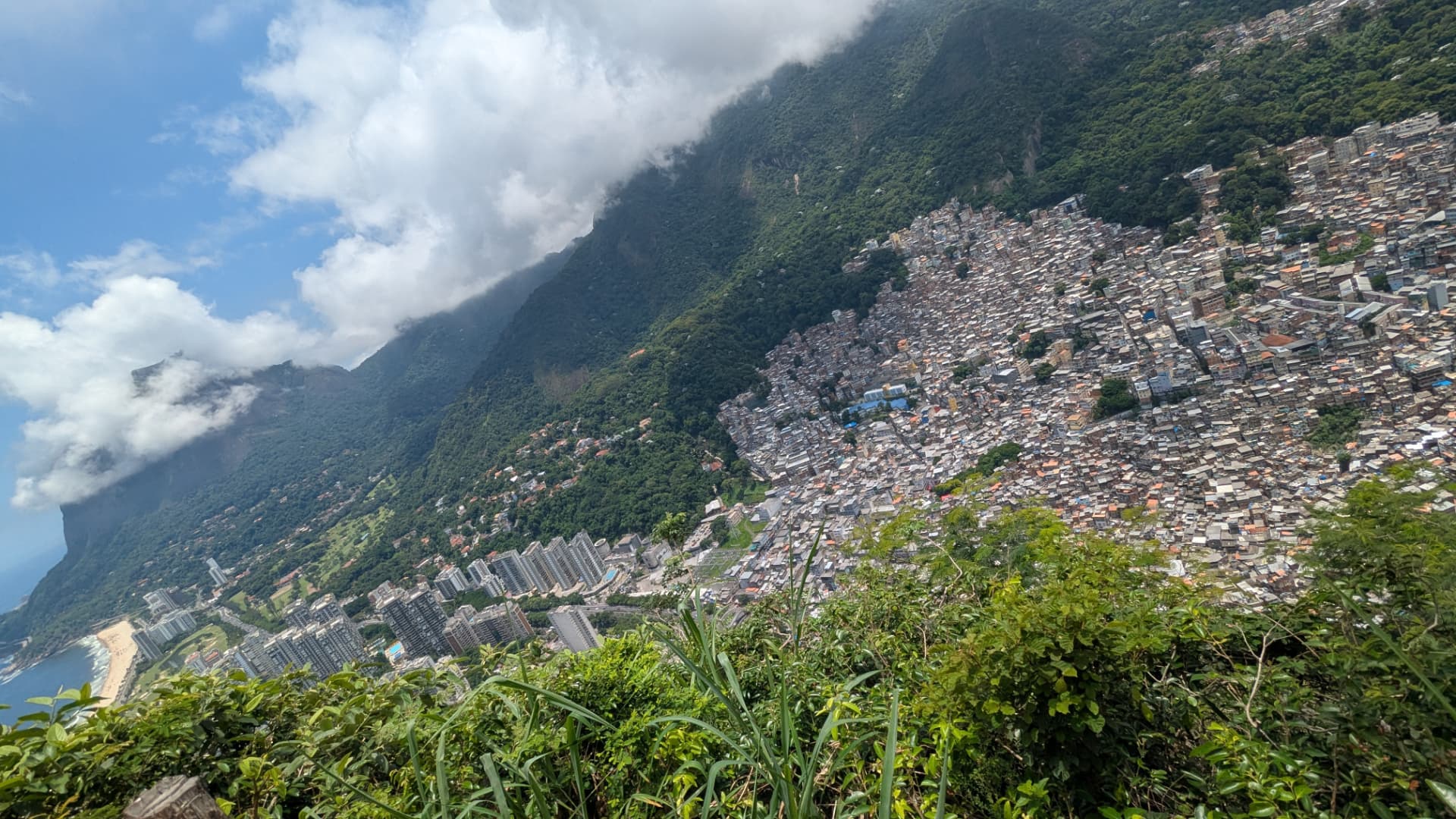
Then the drone rises. At first it hovers low, almost at eye level, a few metres in front of a plain metal door, of the kind hanging on thousands of houses in Rocinha. A nod. The door opens inward. The camera pulls back, glides over the parapet, over corrugated metal, water tanks, aerials – and then the image unfolds: the rooftops of Rocinha, stacked all the way down to the valley floor, the Atlantic behind them, the mountain range to the left, and over it all a light that is still soft at this hour.
Fourteen seconds later, the clip is edited. Music underneath, text on top, vertical format. A few minutes later it is running on Instagram or TikTok and being watched by people who have never heard of Rocinha. For many, this video is their very first encounter with a favela – not through news, not through crime statistics, but through a door opening.
The place carries the name Porta do Céu, "Gateway to Heaven". It is not a monument, not a municipal project, and not a sight in the classic sense. It is a rooftop with a door in a residential neighbourhood. And it is a lesson in how social media creates places today – or more precisely: how it lifts places that have long existed into a worldwide stream of attention.
This article explains what Porta do Céu is, how the trend arose, why this particular motif works, what the boom means for Rocinha – economically and in everyday life – and what a visit looks like that gives the community more than just another video.
What is Porta do Céu?
Porta do Céu is a metal door on a laje – the term used in Brazil for the walkable concrete roof slab of a house. In the morros, the laje is more than a roof: it is a laundry area, a workshop, a party venue, an extra children's room and the building ground for the next storey. Anyone building upward in Rocinha builds on a laje. And anyone with a laje has a view.
The door itself is ordinary. Doors like this secure stairwells, roof access and extensions throughout Rocinha. Its distinctiveness arises purely from its position: it stands so that nothing follows behind it but air. Open it, and it frames the panorama like a picture frame – houses, sea, mountains, sky. That is exactly where the name comes from.
The place lies in a higher-lying area of Rocinha, Rio de Janeiro's largest community, between the affluent districts of São Conrado and Gávea. Rocinha is not a collection of makeshift buildings but a densely built city within a city, with banks, schools, bakeries, workshops and its own economy. Anyone wanting to understand why the panorama from there is so effective should first get to know the community itself.
Photographically, the place is spectacular for three reasons. First, the stacking of elevations: houses stand so close together and so steeply above one another that the camera generates depth without needing to stage it. Second, the contrast: the dense, warm, irregular buildings against the clean planes of sea and sky. Third, the frame: the door conceals the motif before revealing it – a dramaturgical trick that cinema has used for a hundred years.
„It's not the place that has changed, but the number of people who want to see it."
It is important to note what Porta do Céu is not: not a historical monument, not a mirante created by the city, not an official viewpoint with a ticket booth, railings and opening hours. It is part of a house people live in. Whatever order exists there – time slots, agreements, access – has been organised entirely by local people themselves.
Licensed or original photo. No AI-generated images presented as documentary footage.
How did the social media hype begin?
The trend has no founding date and no provable single origin. What can be reconstructed is the technical and media development it fits into. From the mid-2010s, camera drones became small, affordable and stable enough to fly in narrow alleys and over steep hillsides. At the same time, a generation of photographers, videographers and content producers emerged in Rio's communities who documented their own neighbourhoods – rather than waiting for television crews to arrive from outside.
This local media work is the real starting point. Long before international creators travelled there, people in Rocinha were filming the hillside from the air because they knew it and found it beautiful. Out of this practice came the crucial idea: not simply sending the drone over the rooftops, but hiding the launch behind a closed door.
That created a visual formula – and visual formulas are what works in short-video formats. Instagram Reels, TikTok and YouTube Shorts reward clips that build an expectation in the first seconds and pay it off shortly after. The door delivers both: at first banal, then surprising. Anyone who has watched the clip once knows within the first second where it's heading – and watches to the end anyway.
The second accelerator was repeatability. The motif works with any person, any clothing, any music. It is a frame anyone can step into. That turned one video into a template, a template into a format – and the format into a destination. Content generated demand, demand generated new content.
A third factor: naming. As long as a place is just "a rooftop in Rocinha", it stays unsearchable. Once it is called "Porta do Céu", it becomes a term people type into search boxes, write in captions and note in travel plans. From that point, the trend left the social networks and moved into search engines, travel blogs and conversations in hostels.
Why did the place become so popular?
Rio has more spectacular views. From Christ the Redeemer, from Sugarloaf Mountain, from Mirante Dona Marta, you see further and more officially. Yet Porta do Céu performs better on social media than many of these places. That has less to do with geography than with narrative.
Perspective
Classic viewpoints show the city from outside and from above. Porta do Céu shows it from within: you stand in the middle of the buildings, not above them. The view begins on a roof that belongs to someone, and ends at the horizon. This closeness creates a sense of access – a promise that is enormously appealing, especially in travel content.
Contrast
The image thrives on the clash of two textures: the irregular, warm, stacked architecture of the morros and the smooth expanse of sea and sky. This contrast tells, in a single second, what defines Rio – the simultaneity of density and nature, of confinement and openness.
Drone movement
The reverse flight is perhaps the most effective camera movement of the social media era. It removes the viewer's footing while simultaneously opening up space. Combined with a door that opens, it creates a double reveal: first the frame, then the space.
Music and emotion
Short videos work through audio. A drop, a beat, a familiar song – the drone's movement can be timed precisely to the musical high point. What emerges is less information than feeling: expanse, freedom, wonder. This is exactly why people share the clip.
Storytelling in fourteen seconds
The video tells a complete story with a beginning, a turning point and a resolution – in less time than it takes a loading screen to finish. This narrative density is rare. And it is the reason the motif is not just seen, but remembered.
Only with cleared rights and the consent of the residents shown.
The impact on Rocinha
Tourism existed in Rocinha long before Porta do Céu. Since the 1990s, operators have led groups through the community, with very varying quality and very varying respect. What's new is not the visit itself – what's new is the focus of the visit: where tours once covered routes, stories and encounters, some guests today head straight for a single motif.
For the local economy this is, initially, an opportunity. A visit typically means: travel to the entrance, moto-táxi or climb, accompaniment by someone from the community, drinks, perhaps breakfast, perhaps handicrafts, a tip. Each of these steps is income for someone living in Rocinha. For guides, drivers, photographers and small businesses along the route, the boom is genuinely felt.
At the same time, new roles have emerged that barely existed before: people who coordinate access, allocate time slots, limit group sizes, talk to neighbours. This is work – organisational and social. It rarely becomes visible, but it is the precondition for a residential building being able to receive visitors at all without tipping the neighbourhood into chaos.
The downside shows up in the same alleys. Paths built for everyday life – the school run, shopping, deliveries, medical transport – are not visitor thoroughfares. When several groups move through at once, friction results. Add to that cameras that capture not just panoramas but windows, laundry, children, kitchens. Privacy is already scarce in dense construction; drones make it scarcer.
An honest observation is important here: not everyone benefits equally. Those living near the motif but selling nothing mostly experience noise from the trend. Those living further down the hillside may notice nothing at all. A boom concentrated on a few hundred metres does not automatically spread across a community of tens of thousands of residents.
The people behind the trend
A viral place looks effortless in the feed. In reality there is work behind it, carried out mostly by people from Rocinha. Without them there would be neither the motif nor any organised access to it.
They know the paths, the times, the moods and the contacts. They explain context, mediate between guests and neighbours, and carry the responsibility when a situation shifts.
They fly in one of the most challenging environments there is: narrow alleys, cables, hillside wind, people everywhere. Many work with self-imposed rules on flight height and framing.
They shape how Rocinha looks when the world watches. Their decisions about framing and perspective are also political decisions.
Without their consent there would be no access. They bear the immediate consequences – noise, crowding, wear – and negotiate the conditions under which visits are possible.
Padarias, kiosks, cafés, handicrafts, moto-táxis: they turn attention into income. Whether they benefit depends on whether visitors stop or just pass through.
Cultural, educational and media initiatives have been working for years on how Rocinha's story is told. The viral boom meets infrastructure that already existed.
We deliberately do not name individual people as heroes of the trend. Success stories from viral contexts are hard to verify, and the attribution "one person invented it" obscures the fact that many people are always involved in such places – including those who gain nothing from it.
Opportunities and challenges
The honest answer to whether the boom is good or bad for Rocinha is: both, at once, to varying degrees for different people. Anyone telling only one side is telling advertising or cultural criticism – not reality.
- Direct income for guides, drivers, photographers, cafés, kiosks and homeowners.
- New occupations within the community: drone pilots, videographers, social media support for small businesses.
- An image of Rocinha that doesn't begin with crime, but with views, architecture and daily life.
- A reason for visitors to stay longer, ask more questions and spend locally instead of just passing through.
- Negotiating power: when a place generates demand, local people can help shape the terms.
- Overcrowding on narrow stairways and alleys built for everyday routes, not for groups.
- Queues and time pressure – one motif, many people, few minutes per person.
- Privacy: cameras and drones capture rooftops, windows and courtyards where people live.
- Noise, especially early in the morning and late afternoon, when the light is best.
- Commercialisation: when a place becomes a stage, access can become a commodity.
- Pressure of expectation: those travelling for the perfect video can be disappointed – and pass that disappointment on to people who bear no responsibility for it.
- Unequal distribution: proximity to the motif partly determines who earns and who only bears the consequences.
What matters is less the number of visitors than the question of who decides. When local people set access, time slots, group sizes and prices themselves, a place remains manageable. When, by contrast, external providers organise demand and the community merely provides the stage, the very imbalance emerges that has made favela tourism a subject of criticism for decades.
The same question applies to the narrative. A video that reduces Rocinha to a panorama turns a city into a backdrop. Anyone wanting to understand why that distinction is more than semantics will find the grounding in our article Why a Favela Is Not a Slum. And anyone wanting to see how the houses came into being whose rooftops are now being filmed can read Self-Built: The Architecture of the Morros.
The power of Instagram and TikTok
Porta do Céu is not an isolated case. Places whose fame rests almost entirely on recommendation feeds emerge worldwide: a staircase in Lisbon, a café in Seoul, a street corner in Marrakesh. The pattern is always similar.
Recommendation feeds rate the first seconds. A motif with an immediate reveal has structurally better odds than a slow narrative.
Viral places are usually repeatable visual formulas: same frame, interchangeable person. This invites imitation – and multiplies reach.
Once a motif gets a name, images become a search query. From that point, attention moves from social media into search engines and travel planning.
Reach is volatile. Places that only work through a single motif lose attention quickly again – economic dependence on it is risky.
The most important difference from earlier tourism waves is the distribution mechanism. In the past, guidebooks, editors and tour operators decided which place became visible. Today, a recommendation system decides, serving content to people who don't follow the account. This democratises visibility – a video from Rocinha can achieve the same reach as a glossy campaign. But it also strips places of control over when and how strongly demand arises.
For creators, this is a responsibility rarely discussed. A clip that stages a place people live in as a freely accessible photo spot produces behaviour: people arrive unannounced, climb, don't ask. Anyone who instead states in the video that access is organised and runs through local providers measurably changes how visitors behave.
And finally: attention is fleeting. A motif reaching millions today can be exhausted in two years. For a community, it is therefore risky to build economically on a single viral point. Offerings that use the photo spot as an entry point and build something from it are more sustainable: walking tours, workshops, food, art, music.
Can you visit Porta do Céu?
Generally yes – but not spontaneously, not anonymously, and not unconditionally. Access runs through an inhabited house in an inhabited neighbourhood. Everything else depends on arrangements that can change.
Getting there
Rocinha lies between São Conrado and Gávea and is easily reached by bus, taxi or ride service. Within the community, the moto-táxi is the fastest way uphill; the final stretch involves stairs and narrow alleys. Plan for sturdy shoes, water and time – and expect heat, particularly between November and March.
With local guidance
We exclusively recommend visits with knowledgeable local guides from the community. This is not a safety cliché but a practical matter: guides know the way, the arrangements and the current situation – and they ensure that money reaches the place where the visit takes place. For how to recognise reputable providers and how to assess the local situation, see our guide Safety in Rio's Favelas.
Photography
Panorama, architecture, sky: generally unproblematic. People, homes, courtyards, children: only with explicit consent. If unsure, ask – or don't take the photo. A good picture does not justify intruding on someone else's life.
Drones
Brazil has registration and operating rules for unmanned aircraft, and particular caution is required over densely inhabited areas. Regardless of the legal position, the consent of the people below whose roofs are being flown over applies on site. Check the current rules before your trip and clarify use beforehand with your guide – many visitors work with local pilots, which is in every respect the simpler solution.
Documentary photograph with the consent of those depicted.
7 rules for a respectful visit
- 1Come with local guidance. Guides who know the area understand the paths, the agreements and the mood of the day.
- 2Ask beforehand, not afterwards. Access, time slots and photo permission are clarified on site – not created by the camera.
- 3People are not scenery. Portraits, homes and courtyards only with explicit consent.
- 4Be quiet. The place sits in the middle of a residential neighbourhood; speakers and loud groups have no place there.
- 5Share the time. If others are waiting, a few minutes per person is enough – the motif doesn't require half an hour.
- 6Leave money locally. Café, kiosk, craft, a fair tip: the most direct way for a visit to give something back.
- 7Provide context. Anyone posting the video can name Rocinha, explain the place and point to local providers rather than just to themselves.
These rules are not a moral lecture but everyday practice: they are what guides in Rocinha already explain to guests before the climb begins.
Map and recommended route
The overview below places the most important points in context. You'll find an interactive map of all of Rio's communities on our favela overview.
| Point | Type | Note |
|---|---|---|
| Porta do Céu | Viewpoint / photo spot | Rooftop terrace on a residential building in the upper part of Rocinha. Access only by prior arrangement on site. |
| Estrada da Gávea | Main road | The large winding road through Rocinha. The point of orientation for almost all routes in the neighbourhood. |
| Laboriaux | Viewpoint | Rocinha's highest-lying area with a wide view towards São Conrado – quieter than the viral spots. |
| Cafés and padarias along the main road | Local businesses | The simplest way for a visit to bring economic benefit: eat, drink, shop there. |
| Local guide meeting points | Starting point | Usually at the lower access point towards São Conrado. The exact meeting point is communicated at booking. |
| Residential alleys (becos) on the way up | Consideration zone | Narrow everyday paths. Here: be quiet, go slowly, no photos of people without consent. |
- 1. Meet your local guide at the lower access point towards São Conrado.
- 2. A short stop at a padaria: coffee, pão de queijo, initial orientation.
- 3. Drive or climb along the Estrada da Gávea, taking in the view of the main road.
- 4. Move into the becos – from here on, be quiet, go slowly, no photos of people without consent.
- 5. Porta do Céu: allow time for waiting, film briefly, make room for others.
- 6. Return journey with a stop at local businesses, handicrafts or a community project.
Map data will be added once locations are locally confirmed and agreed with those involved.
Timeline: before and after the boom
Because the trend developed organically, it cannot be told with exact dates. This timeline therefore describes phases rather than years – the sequence is verifiable, the exact date is not.
- Before the hype
On one of Rocinha's upper rooftops stands a plain metal door – part of a house that, like many in the morros, has grown over the years. The view from there is everyday life for neighbours, not an attraction.
- Phase 1 · The first drone footage
From the mid-2010s onward, affordable camera drones increasingly produced aerial footage from Rio's communities. Local photographers and videographers discover the rooftop location as a launch point for flights over the hillside.
- Phase 2 · The visual idea
Combining the door with a reverse flight creates a repeatable motif: the door opens, the drone pulls back, the panorama unfolds. The visual idea is decisive – not the location alone.
- Phase 3 · Instagram Reels and TikTok
Short-video formats reward exactly this dramaturgy: surprise in the first seconds, music, a clear payoff. The clip is copied, remixed, rescored – and spreads through recommendation feeds rather than followers.
- Phase 4 · International attention
Creators from Brazil and abroad travel there deliberately. The place gets a memorable name: Porta do Céu – Gateway to Heaven. Search queries and links rise, travel blogs and media pick up the motif.
- Phase 5 · Organisation on the ground
Spontaneous visits turn into a regulated process: sign-up through local providers, waiting times, time slots, agreements with homeowners and neighbours. Small economic cycles form around the access point.
- Today
Porta do Céu is a fixed stop on many Rocinha tours – and, at the same time, a test case for whether social-media tourism benefits a community or burdens it. Access, procedures and costs can change at short notice.
Myths and reality
Porta do Céu was built specifically for Instagram.
No. The door and the roof existed before the place went viral. What's new is the use: an ordinary component on a residential building became a visual motif. The frame is old, the way people look at it is new.
The City of Rio built the viewpoint.
We are not aware of any evidence that this is a municipal project. The location sits on private residential property in a self-built neighbourhood. Access and organisation lie with local people, not with an authority.
Anyone can film there for free, at any time.
Access, time slots, registration and possible contributions are arranged locally and can change. Anyone wanting to go should check with local providers shortly beforehand – and accept that access may not be possible on a given day.
It is an official tourist viewpoint like Sugarloaf Mountain.
No. There is no infrastructure such as a ticket booth, barriers or emergency routes in the sense of a classic attraction. It is a rooftop in a residential neighbourhood – with all the consideration that demands.
Porta do Céu has replaced Christ the Redeemer as Rio's most important motif.
That's marketing talk. Rio's classic landmarks remain by far the city's most visited sites. What is true is that, in certain social-media niches, Porta do Céu was at times extremely prominent.
Everyone in Rocinha benefits from the boom.
No. Those who benefit are mainly the people directly involved: guides, drivers, homeowners, cafés, kiosks, photographers. Neighbours without any involvement often bear only the side effects – noise, crowding, cameras outside their front door.
You need your own drone, otherwise the visit isn't worthwhile.
The view works without a drone too. In addition, Brazil has rules governing the operation of unmanned aircraft, and particular caution is required over inhabited areas. Many visitors therefore work with local pilots.
A viral video is always good advertising for the community.
Visibility is ambivalent. It can break down prejudice and generate income. But it can also flatten, exoticise and create expectations that have little to do with people's everyday lives.
The place is dangerous because it is in a favela.
Blanket statements don't help. The situation in Rio's communities changes situationally and can only be assessed day by day – best through local contacts. That is precisely why we recommend visiting only with knowledgeable local guides.
The images show an untouched panorama with no people.
The frame doesn't lie, but it only tells part of the story. Behind the camera there are often waiting groups, neighbours, washing lines, everyday life. Anyone who bears that in mind understands the place better than any reel.
Anyone taking photos is also allowed to film residents.
No. Landscape is free to photograph, people are not. Images of individuals, homes and interiors only with explicit consent – this applies to phone cameras just as much as to drones.
The hype is a random product of the algorithm.
Algorithms amplify, but they don't invent anything. At the start were people: pilots, guides and creators who recognised, repeated and refined a motif. The feed simply scaled that work.
Voices from Rocinha
This section remains deliberately open. We publish here only statements we have gathered ourselves or demonstrably sourced – no reconstructed quotes, no summarised "typical opinions". Conversations are planned with:
How has their daily work changed since the viral boom – and what do guests ask most often?
How did the motif come about, and what rules do they set themselves when flying over residential buildings?
Who decides on access, and how is dealing with groups organised?
Does the flow of visitors bring economic benefit – or pass the business by?
What is disruptive, what doesn't matter, and what would be a noticeable improvement?
How can the place be depicted without turning people into extras?
Do you live in Rocinha, work as a guide, pilot or photographer – or simply live near the motif? Write to us at info@insidefavela.com. We document perspectives with the consent of those involved.
Photo gallery
Here we show only genuine photographs or clearly labelled illustrations. Images generated by AI are never used as if they were documentary footage.
Licensed or original image, people only with consent.
Licensed or original image, people only with consent.
Licensed or original image, people only with consent.
Licensed or original image, people only with consent.
Licensed or original image, people only with consent.
Licensed or original image, people only with consent.
Glossary
- Porta do Céu
- Portuguese for "gateway to heaven". The name given to a metal door on a rooftop terrace in Rocinha, used as a picture frame for panoramic shots.
- Rocinha
- Rio's largest community, located between São Conrado and Gávea. A densely built neighbourhood with its own economy, infrastructure and culture.
- Laje
- The walkable concrete roof slab of a house. In the morros it serves as terrace, workshop, laundry area, party venue – and the base for future floors.
- Mirante
- Viewpoint. In Rio often an official site with railings; in communities frequently just a well-positioned laje.
- Reel / Short
- Short-video format on Instagram or YouTube, usually vertical, a few seconds to a minute long, set to music.
- Recommendation feed
- A feed that serves content based on presumed interest rather than subscriptions. The reason why clips from unknown accounts can reach millions.
- Reveal
- A dramaturgical device: an image first conceals something and then releases it – at Porta do Céu, the opening door.
- Drone / UAV
- Unmanned aircraft. Brazil has registration and operating rules; particular caution is required over inhabited areas.
- Overtourism
- A state in which visitor numbers exceed the capacity of a place and the quality of life of its residents.
- Community-based tourism
- Tourism organised by local people, in which the proceeds largely remain within the neighbourhood.
- Beco
- A narrow alley between houses. The main thoroughfare in dense communities – and the reason large groups quickly cause disruption there.
- Moto-táxi
- Motorcycle taxi. In Rocinha, the fastest way up the hillside and an economic sector in its own right.
Frequently asked questions
Where is Porta do Céu located?
It is located in Rocinha, Rio de Janeiro's largest community between the districts of São Conrado and Gávea, in a higher-lying residential area of the hillside. It is a rooftop terrace on a private house, not a municipal viewpoint.
Why is it called "Porta do Céu"?
The name means "gateway to heaven" in Portuguese. It describes the visual effect: when a closed metal door on a roof opens, it becomes a frame revealing sky, sea, mountains and the houses of Rocinha behind it.
Is Porta do Céu a historical monument?
No. It is part of an organically grown house. There is no heritage status, no official designation and no tourist infrastructure in the classic sense. Its significance arose culturally and through the media, not administratively.
How did the place go viral?
Through short drone videos: the door opens, the camera pulls back, the panorama unfolds. This motif fits exactly the dramaturgy of reels and TikToks. Through recommendation feeds, the clips reached an audience far beyond Brazil.
Who started the trend?
A single point of origin cannot be reliably established. Local drone pilots, photographers, guides and creators were involved in developing, repeating and spreading the motif. We deliberately do not name any one person as the sole "inventor".
Did the place exist before social media?
Yes. The door, roof and view existed long before the hype. What is new is not the place, but the number of people who want to see and film it.
Can you visit Porta do Céu?
Generally yes, but not spontaneously and not unconditionally. Access is organised locally and can change. Only local providers can give binding information, shortly before your planned visit.
Do you need a guide?
We explicitly recommend it. Guides who know the area know the paths, agreements with residents and the current situation – and ensure that some of the money stays in the community.
What does the visit cost?
Costs arise for travel, a guided tour, possible on-site contributions, tips and spending. We do not give specific amounts because they change and vary by provider. Ask for a clear breakdown before booking.
Is photography allowed?
Panoramas and landscape are generally fine. People, homes, courtyards and everyday scenes only with explicit consent. The community is a place people live, not a set.
Am I allowed to fly a drone there?
Only after clarification. Brazil has registration and operating rules for unmanned aircraft, and particular caution is required over densely inhabited areas. In addition, the consent of the people below is required. Many visitors therefore work with local pilots.
How long do you wait on site?
This varies considerably – from a few minutes to considerably longer waits when several groups arrive at once. Demand tends to be highest at sunrise and sunset.
What time of day is best?
Photographically, early morning and late afternoon are the most interesting. But that is exactly when it is busiest and most disruptive for residents. A visit in the late morning is often a better compromise.
How do you get to Rocinha?
Rocinha lies between São Conrado and Gávea and can be reached by bus, taxi or ride service; within the community, moto-táxis are the fastest way uphill. The final stretch to the rooftop usually involves stairs and narrow alleys.
How strenuous is the walk?
Expect steep stairs, uneven ground and heat. Sturdy shoes, water and some fitness help. For people with limited mobility, access is difficult or not possible.
Is a visit safe?
A blanket answer would not be honest. The situation in Rio's communities can change at short notice. Only an up-to-date, same-day assessment via accommodation, local guides or contacts on the ground is reliable.
How many people visit the place?
We do not have reliable, publicly verified visitor figures. We therefore refrain from citing numbers circulating online that cannot be verified.
Does Rocinha benefit economically from the trend?
Partially. Guides, drivers, photographers, cafés, kiosks and homeowners report increased demand. However, the effect is unevenly distributed and reaches far from all households.
Does the hype harm the community?
It is neither purely good nor purely bad. Opportunities include income and a different image of Rocinha; burdens include crowding, noise, intrusions on privacy and commercialisation of access.
What should you absolutely avoid doing?
Entering houses unannounced, filming people without asking, playing loud music, ignoring barriers or notices, using the place as a backdrop for staged images of poverty.
Can you visit the place meaningfully without a drone?
Yes. The view over Rocinha, the Atlantic and the mountains is impressive even without aerial footage. Many visitors report that the way there – alleys, stairs, everyday life – is actually the more formative part.
Are there alternatives to Porta do Céu?
Rio has many viewpoints, including in other communities. Anyone seeking context rather than a single motif will find it on guided walks through Rocinha or in communities such as Santa Marta or Vidigal.
How do I recognise reputable local providers?
They are reachable, explain the process and costs transparently beforehand, work with people from the community, cancel tours when the situation requires it, and are clear about photography rules.
Am I allowed to use my footage commercially?
That is a legal question that depends on the subject, the people depicted and the type of use. Footage with identifiable people or for advertising purposes requires consent. When in doubt, clarify beforehand.
Is the place changing because of tourism?
Yes, like any place with high demand. This is visible in access rules, small businesses along the route and time slots for groups. Whether this leads to something sustainable depends on who gets a say.
What does Inside Favela do with unverified information?
We don't publish it. We check details on opening times, access, fees, visitor numbers and individuals before publication – or we omit them and note the gap.
Conclusion
Porta do Céu is more than an Instagram motif. It is an example of how an everyday place – a door, a roof, a view – can become visible worldwide within a short time through social media. Nothing about this place was built for fame. What has changed is the way it is looked at from outside.
For Rocinha this means opportunities and impositions at the same time: income for some, disruption for others, a new image projected outward and growing pressure of expectation inward. Whether something sustainable comes of it is decided not by the algorithm, but by whether local people have a say in access, procedures and earnings – and whether visitors are willing to follow their rules.
The best video of this place is therefore not the one with the most views, but the one after which someone stayed longer: to ask, to eat, to listen. Sustainable tourism in Rio's communities begins exactly there – with respect, and with the question of who actually benefits when the world is watching.
Sources & transparency
For this article we drew on the following types of material:
- International and Brazilian media coverage of social media tourism in Rio de Janeiro.
- Academic literature and research on overtourism, community-based tourism and the effect of recommendation algorithms on travel destinations.
- Publicly available information from local tourism initiatives and community projects in Rocinha.
- Our own observations and research on the ground, as well as conversations with people from the community.
We did not use: unsubstantiated visitor and revenue figures, unverifiable individual success stories, and reconstructed quotes. Details on access, time slots and costs are time-dependent and are re-checked before every update. Last editorial review: 06. August 2026.
Further reading: Visiting Rocinha · Safety in Rio's Favelas · Michael Jackson in Santa Marta · Why a Favela Is Not a Slum · Architecture of the Morros · Magazine
Further reading
Babilônia & Chapéu Mangueira: Rio's authentic favelas above Leme
Cornerstone guide to the two neighbouring favelas above Leme: history, community, Atlantic rainforest, viewpoints, safety and practical tips.
The Teleférico do Alemão – what the cable car means for the Zona Norte
History, technology and everyday life of a cable car between mobility, urban development and symbolic politics.