Vidigal 1977: The Night the Community Stayed
A story about houses, neighborhood and the resistance against the removal of a favela in one of Rio de Janeiro's most coveted locations.
How residents organized against the removal of their homes and wrote a chapter of the city's history.
- Location
- Morro do Vidigal, Rio de Janeiro
- Year
- 1977
- Political context
- Brazilian military dictatorship (1964–1985)
- Conflict
- Planned removal and relocation of residents
- Outcome
- The large-scale removal of Vidigal was prevented
- Important note
- Individual families were nonetheless relocated
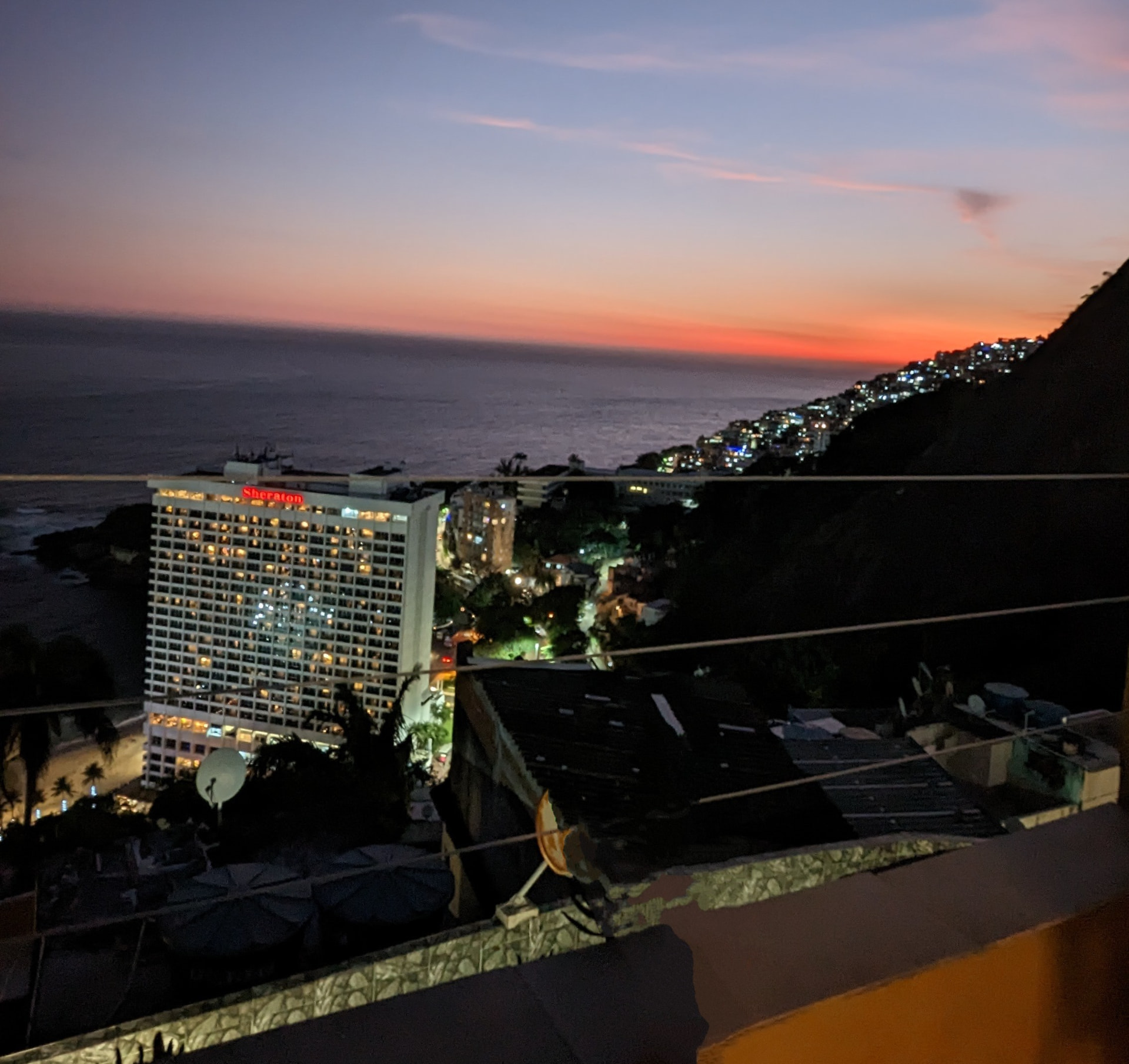
On the morning of October 24, 1977, residents of Vidigal noticed markings and numbers painted on houses. Paint on plaster, numbers on walls. To an outsider, it might have looked like a technical survey — an administrative record, a piece of statistics.
In Rio de Janeiro in 1977, it meant something else. Anyone living in a favela knew that recording buildings often preceded a removal. Numbered houses were houses that had been counted before they disappeared. The markings therefore did not stand for bureaucracy, but for a very concrete danger: the loss of one's own home and of the neighborhood in which it stood.
What happened in the days and weeks that followed is, to this day, one of Rio de Janeiro's most important stories. It is not a story of a miracle, and not one of a single hero. It is the story of a community that organized itself, sought allies, and insisted that an inhabited hillside is not empty building land.
How did a community manage, under a military dictatorship, to assert itself against powerful political and economic interests?
Vidigal Before 1977
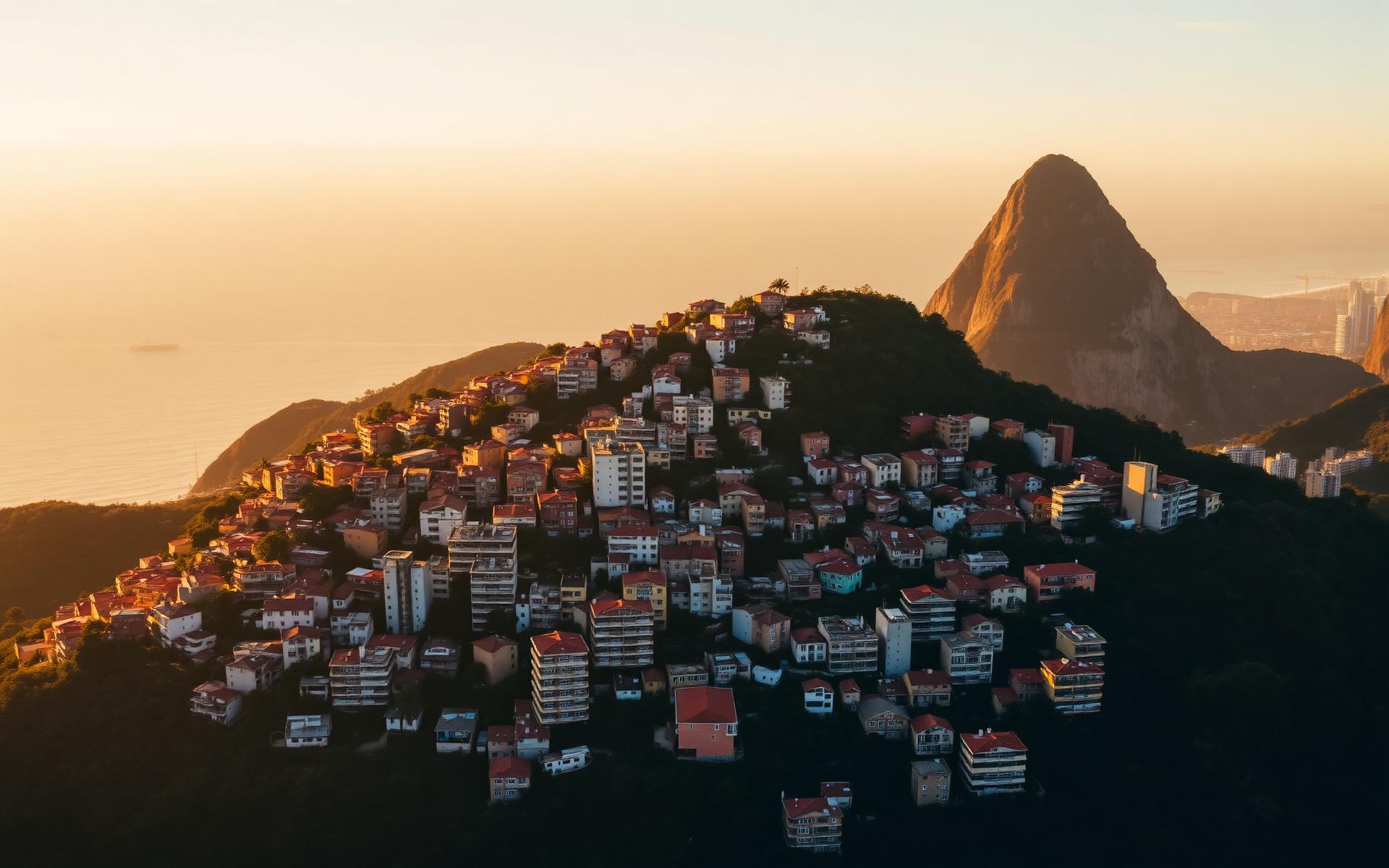
Vidigal sits on the slope of Morro Dois Irmãos, between Leblon and São Conrado, above Avenida Niemeyer. This road has connected the southern neighborhoods along the coast since the early 20th century. Anyone driving along it today sees cliffs, the sea, and above them a dense sea of houses. In 1977 the picture was similar, only built lower and less densely.
The community did not arise from a plan, but as an answer to a simple equation: there was work in the Zona Sul, but no affordable housing there. People working in households, hotels, construction sites, kitchens and workshops needed a place to live that was reachable on foot or with a short commute. The hillside above the road was such a place: unbuilt, steep, unattractive to the formal housing market — and close to everything.
Building was done through self-labor. First small houses of wood and tin, later masonry with concrete supports, set step by step into the hillside. Stairs formed between the houses, stairs became paths, and paths became addresses. Anyone wanting to know how, over decades, individual houses grow into an urban landscape can find a detailed account in our article Self-Built Architecture: The Morros.
Along with the houses, social structures grew: neighborly support, churches, small shops, associations, informal savings circles, childcare shared among neighbors. These structures are crucial for understanding 1977. A community accustomed to laying water pipes together and repairing stairs together can also respond to a threat together.
From the 1950s and 1960s, residents report recurring uncertainty: rumors of evictions, visits from officials, offers and threats. The conflict of 1977 therefore did not strike a community hearing about removal for the first time, but one that had known this possibility for years.
The resident association, the Associação de Moradores, became central early on. It handled everyday matters, negotiated with utilities and authorities, collected signatures, and was the address outsiders turned to. Sources differ on its founding date, name, and board composition; what is undisputed is that the association existed and was capable of acting in 1977.
Archival research is ongoing; publication only once rights are cleared.
Will be completed with alt text, caption, date, creator, source, license and historical context. No AI-generated images imitating documentary photography; illustrations are labeled as such.
Rio and the Politics of Favela Removal
To understand 1977, one must look at the decades before it. Since the 1960s, Rio de Janeiro had pursued a policy aimed not at improving favelas, but at eliminating them. The term for this was "remoção": removal.
The logic behind it was a mix of housing policy, notions of order, and economic interest. Favelas were officially portrayed as makeshift, disorderly, hygienically questionable and urbanistically undesirable. At the same time, many of them stood where land values were rising: along the coast, in view of the sea, within reach of wealthy neighborhoods.
Relocation typically led to "conjuntos habitacionais," public housing projects in distant parts of the city, mostly in the west. For affected families, this was not a move within an urban fabric, but a rupture. Anyone who worked in Leblon and suddenly faced a two- to three-hour commute each way often lost their job. Anyone who relied on a neighborhood for childcare, customers, or help in illness lost that too.
Several communities in the Zona Sul and other central locations were removed during this period. Praia do Pinto, Catacumba, Ilha das Dragas and Esqueleto are among those cited in the research literature. We deliberately avoid exact totals of families removed: studies cite very different figures depending on time period, definition, and source base, and a number without methodology only creates a false sense of precision.
Over all of this lay the political framework of the military dictatorship. Since 1964, political participation, press freedom, and the right to organize had been severely restricted. Protest could be dangerous, and criticizing state projects was risky. This does not make what happened in Vidigal more heroic, but it explains why the resistance ran mainly through law, church, personal contacts, and publicity — and less through demonstrations.
At the same time, by the late 1970s the dictatorship was in a phase of slow opening. Critical reporting was again somewhat possible, and social movements gained more room to maneuver. Historical research suggests this constellation was not unimportant to the outcome of the conflict in Vidigal.
Why Vidigal Was a Coveted Location
Vidigal sits at one of the most spectacular spots in the city: above the sea, with views of Leblon, Ipanema and the open Atlantic, right at the edge of the forest on Morro Dois Irmãos. What was everyday life for residents was an exceptional plot of land for the real estate market.
As the Zona Sul expanded toward São Conrado and later Barra da Tijuca, the value of the location rose further. Hotels, high-end housing, and tourism uses were a live topic along this stretch. That put two competing ideas of what this hillside should be abruptly side by side: home to a working community, or an investment site.
Several accounts mention a planned hotel or upscale housing project in connection with 1977. However, the details of developers, planning status and permits differ, and we do not have consistent archival documentation. We therefore state: the economic interest in this location is well documented; the claim that a specific hotel project was the sole, clearly documented trigger is not.
Reports and community memory also mention a designation for a particularly affected section, recorded among other things as "Morro 314." Different explanations exist for the origin and exact boundaries of this term; we present it here as a traditional label, not as an established territorial definition.
Will be completed with alt text, caption, date, creator, source, license and historical context. No AI-generated images imitating documentary photography; illustrations are labeled as such.
October 24, 1977
October 24, 1977 is the date on which the story crystallizes. That day, markings and numbers were noticed on houses. In the community's memory, this is the moment an abstract possibility became an immediate threat.
What happened afterward can be followed in its broad outlines: news spread quickly from house to house, meetings took place, the resident association took over coordination, and support was sought outside the community. The precise sequence of individual days — who spoke with whom and when, which authority gave which instruction — can no longer be fully reconstructed today.
- Markings and numbers on houses in October 1977
- A concrete threat of removal for a section of the community
- The existence and activity of the resident association
- Involvement of legal and church support
- Prevention of the large-scale eviction
- Individual families affected by demolition or relocation
- The sequence of individual days and nights
- The extent and duration of collective vigilance
- The number of people who gathered
- Specific statements by individual participants
- The roles of individual people relative to one another
- The notion that everything was decided in a single night
This distinction is not legal hair-splitting. It is the difference between a story one has to believe and one that can be followed step by step. Vidigal's resistance needs no invented scenes; the documentable facts are entirely sufficient.
From residents' perspective, these weeks were about very practical questions. Who is affected? Who has papers, receipts, bills, anything proving how long they have lived there? Who knows someone who studied law? Who can ask at the church? Who goes to the newspaper? And: what do we do if machines show up tomorrow morning?
Archival photograph sought — please contact the editorial team with leads.
Will be completed with alt text, caption, date, creator, source, license and historical context. No AI-generated images imitating documentary photography; illustrations are labeled as such.
Not All Residents Wanted to Stay
A community is not a homogeneous political unit. Attitudes in Vidigal in 1977 were not uniform either, and any account claiming otherwise oversimplifies.
Some residents wanted to stay and resisted. Others saw a possible improvement in the housing on offer: their own bathroom, solid walls, secure water and electricity connections, a document confirming rights. Anyone living with six people in two rooms without sewage had good reason to consider that option seriously.
Still others were simply afraid. Resisting a state initiative was not without consequences under the dictatorship. Some doubted the chances of success and did not want to end up with neither a house nor an offer. Decisions depended on housing conditions, family size, income, place of work, health, and personal experience.
We do not judge these decisions. Staying was not inherently brave, leaving was not inherently betrayal, and accepting an apartment was not naivety. These were decisions made under pressure, with incomplete information and no guarantees — exactly the kind of decision that historical narratives later tend to smooth into clear-cut positions.
The Resident Association Organizes the Resistance
In 1977, the resident association was the backbone of the resistance. Its work was unspectacular, and that is exactly why it was effective.
- Meetings: Regular gatherings created a place where information could be checked and rumors sorted out. In a situation where fear travels faster than facts, that is a crucial function.
- Passing on information: House to house, through neighbors, churches, shops and stairwells. There were no mobile phones and no mailing lists; communication meant walking.
- Documentation: Who has lived where since when, who is affected, what evidence exists. This collection was the basis for every legal argument.
- Contact with lawyers: The association established the connection to legal counsel and translated between two worlds — everyday life on the hillside and the language of the law.
- Contact with church and politics: Existing relationships opened access to institutions residents could not have reached on their own.
- Negotiation: Not every dispute was settled in court. Much happened in conversations that achieved delays, reviews, or partial solutions.
- Publicity: Contacts with journalists turned a local matter into a case discussed across the city.
The sequence matters: the organization existed first, then the crisis came. Communities that must improvise in an emergency are far worse positioned than those that already have a representative body, a minute book, and phone numbers.
Community Leadership and Key Figures
The resistance had faces, but no lone savior. The cards below name figures who recur in accounts of the Vidigal case — each with a note on what is documented and what is not. There are no invented quotes here.
Named in accounts of the 1977 resistance as a central figure in organizing and representing Vidigal externally. His name is firmly anchored in the community's culture of remembrance.
Source status: Community-affiliated publications and personal recollections; individual roles and time periods are described differently and still require editorial verification.
Called meetings, distributed information, registered those affected, established contacts with lawyers, the church, politicians and the press, and led negotiations.
Source status: Reports from the resident association, testimony from eyewitnesses, research literature on resident organizations in Rio.
Advised on housing rights, documented residents' living situations, attempted to delay or suspend the removal, and accompanied negotiations.
Source status: Literature on the Pastoral de Favelas and legal counsel for threatened communities; individual cases relating to Vidigal are not consistently documented publicly.
Named in accounts of the Vidigal case as a supporter from the political-institutional sphere. We do not attribute an official title to him for 1977, as long as his function that year is not clearly documented.
Source status: Secondary accounts; archival confirmation of his role at the time is still pending.
Provided meeting spaces, mediated between residents and authorities, and offered public advocacy under the banner of the "option for the poor".
Source status: Church archives and research on the Pastoral de Favelas; attitudes within the church were not uniform.
Carlos Duque is named particularly often in Vidigal's memory. This is no coincidence: in conflicts like this, community leaders end up bundling tasks no one else takes on — speaking, writing, traveling, negotiating, enduring. At the same time, focusing on a single person is a typical way of shortening history. Reducing Vidigal 1977 to one name turns a collective political achievement into a biography.
We therefore put it this way: individual people played important roles. The success rested on collective action.
Legal Support
Legal counsel in this conflict was not a formality but the most important tool for gaining time. An announced removal that gets delayed is a removal that can still be argued against.
The options were limited. An explicit constitutional right to housing did not exist in its present form in the Brazilian constitution at the time; it was added only later. Courts operated under the conditions of the dictatorship. Even so, there were points of leverage: questions of jurisdiction, the legality of individual measures, deadlines, compensation, and long-term use of land.
In practice, legal work meant above all documentation: how long has a family lived here? Are there bills, witnesses, photographs, certificates? Residents did this collecting themselves; lawyers translated it into petitions and legal filings.
We deliberately do not name case numbers or specific court rulings. In the accounts available to us, they are not clearly documented, and invented precision would be especially harmful here.
[DOCUMENT: Legal petition]
Title, date, author, source, rights, transcript and context to follow.
[ARCHIVE: Newspaper clipping, 1977]
Press reports will be labeled with title, date and rights holder.
Church and the Pastoral de Favelas
Without church structures, the resistance in Vidigal would have been harder to organize. There are several reasons for this, and none of them is purely religious.
First, the church was one of the few institutions that had a relatively protected space during the dictatorship. Meetings in a church context were less vulnerable than political gatherings. Second, the church had networks: to lawyers, journalists, administration, and politics. Third, it carried moral authority that could be used publicly.
The Pastoral de Favelas emerged in this period within the Archdiocese of Rio de Janeiro — a structure supporting residents of threatened communities, particularly with legal advice and mediation. The Vidigal case is regarded in many accounts as formative for this work: it showed that legal accompaniment and public advocacy could genuinely make a difference.
Theologically, this rested on the "option for the poor," an influential stance in Latin American Catholicism of the 1960s and 1970s. It was, however, not uncontested within the church. There were progressive priests and laypeople who engaged, and conservative elements who rejected it. The church as a whole was not Vidigal's savior; individual church figures were important allies.
Political Support and Publicity
Alongside the legal channel ran political contacts. Individual people from the institutional sphere carried the cause to where decisions were being prepared. How far this support reached is hard to reconstruct, because much of it happened in conversations rather than in records.
Secondary accounts mention Aluísio Teixeira in this context. We present him as a supporter without attaching an official title for 1977: later roles must not be projected back onto earlier ones, and we have no archival confirmation.
The second resource was publicity. Press coverage of an impending eviction in a prominent location raised the political cost of harsh action. For a government that was in a phase of slow political opening, an image of bulldozers over Leblon was not a desirable one.
At the same time, the limits were clear: opposition was restricted, censorship persisted, and favela residents had little institutional power. Success did not arise because the system was on their side, but because they made use of several narrow paths at once.
The Night Watches and the Residents' Presence
Part of the story of 1977 is the image of watchful neighbors: people who stayed by their houses, informed one another, and paid attention to whether vehicles or machines were coming up the hill.
For the exact extent and duration of such watches, we do not have solid sources. We therefore present this part as a level of memory: in Vidigal's collective memory, the resistance condenses into the image of a community that stayed by its houses.
That is not a flaw of the oral tradition but how it functions. Historical memory compresses long, confusing processes into a few symbolic scenes. A single night then stands for weeks, an image for many decisions. Knowing this allows one to take the narrative seriously without mistaking it for a record.
What is documentable is the core: residents remained present, visible and reachable. It was precisely this presence that made the community a party that could not simply be overlooked.
What Was Actually Demolished or Removed
Vidigal remained. That is why this story is told. But it is not a pure success story.
Individual families and houses were affected by demolition and relocation. Sources give differing accounts of their number, the exact timing, and the destinations involved. Relocations at the time typically went to public housing projects in distant parts of the city. We will list specific projects only once their connection to Vidigal 1977 is robustly confirmed.
For the families affected, the outcome was therefore not a victory. They lost their home, their neighborhood, and often their commute to work — while, a few hundred meters away, the community continued to exist. This unevenness is part of the truth of 1977.
Why Vidigal Remained
There is no single-cause explanation. What worked in 1977 was an interplay of factors — and each one alone would probably have been too weak.
An existing resident association, meetings and neighborhood structures enabled fast, coordinated action.
Lawyers translated the threat into legal steps and bought time — the most important resource in the conflict.
Church figures provided spaces, mediation and moral authority at a time of restricted political participation.
Individual institutional supporters could carry concerns to where decisions were made.
Press coverage raised the cost of forceful action and made the community visible.
The conflict did not end after a few days. It demanded endurance, presence, and a willingness to keep negotiating.
Added to this were circumstances no one in Vidigal could influence: the political opening that had begun, growing criticism of removal policy, economic constraints, and the experience that relocations were expensive and rarely worked well. The resistance met a policy whose self-evidence was starting to crumble.
Was Vidigal the Turning Point of Removal Policy?
Part of the research literature sees Vidigal as the symbolic end of large-scale removal policy in Rio de Janeiro. The argument: if a community can remain in one of the city's most valuable locations, the instrument of eviction loses its self-evidence.
Against this stands a sober finding: policy did not change overnight. Evictions and relocations continued in the following decades, sometimes tied to infrastructure projects, risk-area designations, or mega-events. Anyone declaring 1977 the final line ignores later losses.
The more defensible formulation lies in between: Vidigal was a concrete success and, at the same time, became a reference case that later movements could invoke. Symbolic power is not a side note — but it does not substitute for policy.
The Visit of Pope John Paul II
In 1980, Pope John Paul II visited Vidigal as part of his trip to Brazil. The visit drew international attention to a community that, three years earlier, had mainly been discussed in connection with an impending eviction.
In the memory of many residents, that day stands for recognition: the hillside was suddenly a place the world could see. When it comes to interpreting the 1977 conflict, caution is warranted. The visit gave the community visibility and support, but it was neither the cause nor the conclusion of the resistance. Vidigal did not remain because the Pope came.
A follow-up article is in preparation: "Vidigal 1980: When the Pope Visited the Favela."
Archival material only with rights clearance.
Will be completed with alt text, caption, date, creator, source, license and historical context. No AI-generated images imitating documentary photography; illustrations are labeled as such.
Memory Within the Community
The story of 1977 is passed down in Vidigal mainly by word of mouth. Older residents tell it to their children and grandchildren, guides tell it to visitors, local associations and community media keep it present. Documentaries and cultural projects have recorded parts of it.
This form of transmission has strengths and weaknesses. It preserves perspectives found in no government file: what fear felt like, what a meeting meant, why some families left. But it also changes over time — details shift, roles grow larger, sequences shorten.
The history of communities is not preserved solely in official records. Oral memories, family archives and local organizations are important sources too. Differences between these sources are presented transparently.
A Home Is More Than a Property
When removal is discussed in planning documents, it is described in terms of buildings, land and costs. For the people affected, it is about something else.
What can be lost: the neighborhood one grew up in. Family networks that make care and support possible. The commute that could be done on foot. The children's school. The customer base of a small shop. The church community. The mutual help available in case of illness. The memories tied to particular spaces. And access to the city itself — to work, education, health, and culture.
Added to this is the material value of one's own labor. Houses in favelas are usually built over years through personal effort, financed out of ongoing income, built with relatives and neighbors. A demolition destroys not just a building, but the savings and working hours of one or more generations. Our article Self-Built Architecture: The Morros describes in detail how this building process actually works.
From Removal to Gentrification
Today, no bulldozer threatens Vidigal. Yet the question of who gets to stay still arises — just in a different way.
Since roughly the 2010s, Vidigal has become internationally known: for its views, for hikes up Dois Irmãos, for restaurants, parties, and vistas otherwise seen only from Zona Sul hotels. With this came visitors, rentals, investors, and buyers. Properties once traded exclusively within the community became attractive to outsiders.
Brazil has a term for this phenomenon: "remoção branca" — removal without demolition, in which rising prices and rents take over the role once played by machines. Those who can no longer pay the rent move away; those who get a good offer sell. Both happen voluntarily, and both are displacement nonetheless.
Today's situation is not identical to 1977. Back then, state planning stood against residents; today market mechanisms are at work, ones from which individual residents can also benefit. Specific figures on rents, sale prices and trends require current research and evidence; we bring these together in a dedicated article rather than estimating them here.
What has stayed the same is the underlying question: who gets to keep living in one of Rio de Janeiro's most coveted places? In 1977 it was posed with markings on walls; today, with prices.
What the History of Vidigal Means Today
Vidigal 1977 is a reference case for what urban studies calls the "right to the city": the claim to be part of the city and to be able to remain where one's life is rooted. The right to housing is today enshrined in the Brazilian constitution — won, in part, through conflicts like this one.
The second lesson is more mundane: political organization is work. Keeping lists, calling meetings, writing minutes, maintaining phone numbers, talking to authorities, talking again. None of it is romantic. Exactly that was the precondition for Vidigal being able to act in 1977.
Third, the case shows the value of local knowledge and local self-representation. Resident associations are not folklore, but infrastructure. Where they work, a community has a voice that counts — with administration, investors, and media alike.
And fourth: memory is protection. Communities that know their own history know that they can act. That is why passing this story on to younger generations is not nostalgia, but precaution.
Myth and Reality
| Myth | Reality |
|---|---|
| "All of Vidigal was to be demolished in a single night." | The threat was real, but it unfolded over a longer period and affected particular sections of the community in particular. The title of this article is a phrase from collective memory, not a description of events. |
| "No resident wanted to move." | Some families saw the housing on offer as a possible improvement to their living conditions; others resisted firmly. Both were understandable decisions made under pressure. |
| "A single person saved Vidigal." | The resistance rested on collective action and a network of the resident association, lawyers, church figures, political contacts and public attention. Individual people played important roles, but none was decisive alone. |
| "Not a single house was removed in 1977." | Individual families were affected by demolition and relocation. The large-scale eviction was prevented — that is different from a threat that had no consequences. |
| "Vidigal marked the end of all forced evictions in Rio." | Vidigal became an important symbol, yet evictions and relocations continued in later decades, sometimes tied to infrastructure and mega-event projects. |
| "The conflict was only about a planned luxury hotel." | Plans for high-end development of the hillside are mentioned in several accounts. However, the sourcing on project status and parties involved is inconsistent; economic interest in the location is the better-documented finding. |
| "The church saved the community." | Church figures offered legal advice, spaces and publicity. The initiative, however, came from the residents, and attitudes within the church toward engaging with favelas varied. |
| "Resistance was hopeless under the dictatorship." | Political participation was severely restricted and risky. Even so, there was room to act: legal channels, church networks, press coverage and institutional contacts. Vidigal shows how narrow — and yet how effective — that room could be. |
| "The residents were passive victims of state planning." | The residents acted as agents: they documented, organized, negotiated and sought allies. That is precisely what distinguishes Vidigal from a pure story of loss. |
Timeline: Vidigal and Removal Policy
Each entry is marked with a note on the degree of historical certainty. Years without a clearly documented source basis are labeled accordingly.
- from roughly the 1940sscholarly documentedGrowth on Morro Dois Irmãos
A permanent settlement takes shape on the slope above Avenida Niemeyer. Residents build their own houses, with paths and stairs emerging alongside construction. Sources differ on the exact start of settlement.
- 1950s–1960smultiply attestedDensification and early fears of removal
Vidigal grows with the city: jobs in Leblon, Ipanema and later São Conrado shape residents' daily routes. At the same time, Rio expands its policy of "remoção" (removal). Residents report recurring uncertainty about the future of their houses.
- 1960s–1970sscholarly documentedRio clears favelas in the Zona Sul
Several communities in desirable locations are removed, families resettled in housing projects far from their old neighborhoods. Studies cite different figures for the scale of these relocations, depending on methodology and time period.
- 1970sto be verifiedThe resident association becomes the community's voice
The Associação de Moradores becomes the central point of contact, internally and externally. It organizes meetings, gathers documentation, and stays in touch with supporters. Accounts differ on its founding year and board composition.
- October 24, 1977multiply attestedMarkings and numbers appear on houses
Residents find markings and numbers painted on houses. These are understood as preparation for a removal. A particular section of the community is affected — not the entire hillside.
- Late October / November 1977memoryMobilization and search for support
Meetings, house-to-house information sharing, contacts with lawyers, church figures, politicians and the press. The precise sequence of individual days can no longer be fully reconstructed today.
- 1977/1978disputedThe removal is limited
The large-scale eviction is not carried out. Individual families are nonetheless affected by demolition or relocation. Accounts differ on the number, timing and destinations involved.
- Late 1970sscholarly documentedThe Pastoral de Favelas grows in importance
Church structures supporting threatened communities expand, offering legal advice and mediation. Vidigal is regarded in many accounts as a formative case for this work.
- 1980archivally documentedPope John Paul II visits Vidigal
The papal visit draws international attention to the community. It occurs close in time to the 1977 conflict, but it is neither its cause nor its resolution.
- 1980s–2000sscholarly documentedUrbanization and consolidation
Public programs gradually bring infrastructure; houses are massively expanded. Vidigal remains and grows denser.
- since roughly 2010to be verifiedTourism, investment, new questions of displacement
Views, restaurants and nightlife attract visitors and buyers. Rising prices raise the question of who gets to stay all over again — this time economically rather than by bulldozer.
- todaymultiply attestedA culture of remembrance
Older residents, local associations, community media and walking tours keep the story of the resistance alive and pass it on to younger generations.
Historical Map (In Preparation)
A cartographic depiction of the conflict is planned. It will show several layers, each with its source noted and, where needed, the label "approximate location based on available sources."
- Vidigal and Morro Dois Irmãos
- Avenida Niemeyer as the connection to Leblon and São Conrado
- The section particularly affected in 1977 (approximate location)
- Leblon and São Conrado as neighboring districts
- Possible relocation destinations (only once documented)
- Church and institutional points of contact
- Present-day memorial sites and gathering points
Until the historical map is published, the interactive overview shows the present-day location of the communities. View the map
Archive and Documents
This article is meant to grow, over time, into a small public archive. Each document will be published with title, date, document type, creator, source, rights, a transcript or summary, editorial context, and a note on possible gaps.
Digitized copies of Brazilian daily newspapers; title, date, rights holder and brief context will be added prior to publication.
Access only with the association's consent; transcript and context are planned.
Legal-counsel notes and correspondence; review is still pending.
We do not publish case numbers or rulings unless they are archivally confirmed.
Only with proof of authorship and license. No AI-generated images imitating historical documentary photography.
Historical boundaries are labeled as "approximate location based on available sources".
Recording, date, consent and authorized quotation are all documented.
Excerpts only with rights clearance; context and year of production are indicated.
Voices from Vidigal
The people who should speak about 1977 most of all are those who lived through it. We are building an interview series toward that end. Until conversations are conducted and authorized, we deliberately leave empty spaces here — we do not invent quotations.
Eyewitnesses who lived in Vidigal in 1977
We record: name, connection to Vidigal, role in 1977, interview date, authorized quotation, audio or video, and consent to publish.
Members of the resident association at the time
We record: name, connection to Vidigal, role in 1977, interview date, authorized quotation, audio or video, and consent to publish.
Children and grandchildren of families involved
We record: name, connection to Vidigal, role in 1977, interview date, authorized quotation, audio or video, and consent to publish.
Families who were relocated at the time
We record: name, connection to Vidigal, role in 1977, interview date, authorized quotation, audio or video, and consent to publish.
Historians studying removal policy in Rio
We record: name, connection to Vidigal, role in 1977, interview date, authorized quotation, audio or video, and consent to publish.
Church workers connected to the Pastoral de Favelas
We record: name, connection to Vidigal, role in 1977, interview date, authorized quotation, audio or video, and consent to publish.
Lawyers involved in housing-rights cases
We record: name, connection to Vidigal, role in 1977, interview date, authorized quotation, audio or video, and consent to publish.
Guides and cultural figures from Vidigal
We record: name, connection to Vidigal, role in 1977, interview date, authorized quotation, audio or video, and consent to publish.
Did you experience these events yourself, or do you hold documents from this period? Tips are reviewed editorially and may help expand this historical archive: info@insidefavela.com.
Glossary
- Remoção
- State-organized removal of residents and houses from favelas, usually combined with relocation to public housing projects far from the previous neighborhood.
- Remoção branca
- "White removal": indirect displacement through rising rents, prices and market pressure rather than demolition.
- Associação de Moradores
- Resident association. Local self-organization that coordinates a community internally and represents it externally.
- Pastoral de Favelas
- Church structure supporting favela residents, including legal advice, mediation and public advocacy.
- Morro
- Hill; in Rio also the colloquial term for the communities built on the hillsides.
- Conjunto habitacional
- Public housing complex into which relocated families moved — often far from work, school and their old neighborhood.
- Direito à cidade
- Right to the city: the claim to participate in the city and its opportunities and to be able to remain where one's life is rooted.
- Direito à moradia
- Right to housing; enshrined in the Brazilian constitution today, but far more weakly protected in law in 1977.
- Ditadura militar
- Military dictatorship in Brazil, 1964–1985, marked by severely restricted political participation, censorship and persecution.
- Usucapião
- Adverse possession: a legal mechanism to claim rights to a property through long-term, uncontested use.
- Autoconstrução
- Self-building: the gradual construction of one's own house through personal labor — central to understanding what is lost in a demolition.
- Mutirão
- A communal work effort by neighbors, for instance in building or repairing paths.
- Comunidade
- Community; a widely used, less stigmatizing term for favela in Brazil.
- Culture of remembrance
- The way a community passes down, interprets and shares events — often condensed into a few memorable images.
Frequently Asked Questions
What happened in Vidigal in 1977?
In 1977, a threat that had existed for some time intensified: on October 24, residents found markings and numbers painted on houses, understood as preparation for a removal. A particular section of the community was affected in particular. Residents organized resistance, sought legal, church and political support — and the large-scale eviction was ultimately not carried out. Individual families nonetheless lost their homes.
Was Vidigal supposed to be entirely demolished?
Accounts differ. What is documented is a concrete threat to part of the community; in the memory of many residents, the entire favela felt at stake. A plan for the complete removal of the whole community cannot be conclusively proven from publicly accessible sources.
Why did authorities want to remove residents?
In the 1960s and 1970s, Rio pursued a policy of "remoção": favelas in central and valuable locations were cleared and families relocated to distant housing projects. Behind this stood housing-policy ideas, notions of order, and economic interest in desirable land.
What did the markings on the houses mean?
In practice, markings and numbers served to record buildings. For residents, they were not a technical process but a signal: recording often preceded removal. Whether and to what extent they were legally binding in 1977 is not clearly documented.
When did the resistance begin?
Not on October 24, 1977. The resident association and neighborhood structures already existed beforehand; fears of removal had circulated in the years before. October 1977 marks the intensification of an organization that already existed.
What role did the resident association play?
It was the central institution: it called meetings, spread information, registered those affected, led negotiations, and established contacts with lawyers, church figures, politicians and the press. Without this structure, a coordinated response would hardly have been possible.
Who was Carlos Duque?
Carlos Duque is named in accounts of the resistance as a central figure in the community's organization and is present in Vidigal's culture of remembrance. We do not portray him as the sole "savior": the success rested on collective action. Individual biographical details still require editorial verification.
What role did the church play?
Progressive church figures provided spaces, mediation, publicity and, above all, access to legal advice. The church was not unified, however: not all parts of the institution supported this engagement equally.
What is the Pastoral de Favelas?
A church structure linked to the Archdiocese of Rio de Janeiro that supported favela residents — with legal advice, accompaniment in housing conflicts, and public advocacy. It emerged and grew in the context of the struggles over removals in the 1970s.
What role did Aluísio Teixeira play?
He is named in secondary accounts as a supporter from the political-institutional sphere. We deliberately avoid naming an official title for 1977 as long as his function at the time is not archivally confirmed — later titles must not be projected back onto earlier roles.
Were families removed from Vidigal?
Yes. Even though the large-scale eviction was prevented, individual families were affected by demolition or relocation. These losses are part of the story of 1977 and are often overshadowed by a purely triumphant narrative.
Where were affected families relocated?
Relocations at the time typically went to public housing projects in distant parts of the city, especially in the Zona Oeste. Sources give differing destinations for Vidigal; we will list specific projects only once the connection is robustly documented.
Was a luxury hotel planned?
Plans for high-end development of the hillside are mentioned in several accounts, sometimes as a hotel project, sometimes as housing. Details on project status, investors and permits vary. What is confirmed is the general economic interest in this coastal location.
What role did Oscar Niemeyer play?
Avenida Niemeyer below Vidigal is not named after the architect Oscar Niemeyer, but after the Niemeyer family in connection with the road's construction. We are not aware of a documented role for the architect Oscar Niemeyer in the 1977 conflict — this confusion is common.
Why do sources differ on individual details?
The conflict fell during the military dictatorship, a period of restricted press freedom and public access to records. Much was not documented, or was documented incompletely, while other parts survive mainly through oral tradition. Memory also tends to condense events into memorable scenes.
Was Vidigal the turning point of removal policy?
Part of the research literature views Vidigal as a symbolic turning point in Rio's large-scale removal policy. At the same time, policy did not change overnight, and later evictions continued to occur. Its significance lies in the combination of a concrete success and symbolic power.
What happened after 1977?
Vidigal remained, continued to grow, and was gradually provided with infrastructure over the following decades. The resident organization remained a point of reference, and the experience of 1977 continued to resonate in later struggles over housing rights.
Why did the Pope visit Vidigal in 1980?
John Paul II's visit took place in the context of his trip to Brazil and the church's outreach to poor communities. It drew international attention to the community. It was not, however, the reason Vidigal remained standing.
How does Vidigal remember the resistance today?
Mainly through oral tradition within families, through older residents, local associations, community media, documentaries, cultural projects and historical walking tours. Official memorial sites are less prominent than the story itself.
Can you visit historical sites of the resistance?
You can visit Vidigal and see the everyday places where the conflict unfolded — the main street, meeting places, the hillside, Avenida Niemeyer. For historical context, guided walks with guides from the community, who know the story firsthand or secondhand, are worthwhile.
What is the connection to today's gentrification?
The mechanisms have changed: instead of markings on houses, it is now prices, rents and investment that shape events. The underlying question remains the same — who is allowed to keep living in one of Rio's most coveted locations? Specific price trends need to be researched and documented separately, as they stand today.
How safe is it to visit Vidigal today?
Vidigal is visited regularly, but the situation can change at short notice. We recommend visiting with a local guide and checking the current situation on site. We cover this in detail in our guide to safety in Rio's favelas.
How does Inside Favela handle uncertain historical claims?
We label the degree of certainty: archivally documented, scholarly documented, multiply attested, individual memory, disputed, or still to be verified. Where sources contradict each other, we make that contradiction visible rather than resolving it.
Conclusion
Vidigal did not remain because of a single hero, nor because of one dramatic night. The community remained because residents organized themselves, because they found allies, because they used legal channels, and because they insisted that their houses and their neighborhood are part of Rio de Janeiro.
Part of this story is also what was lost. Individual families lost their homes or were relocated. Their experience easily disappears behind the narrative of successful resistance — and that is exactly why it deserves to be told.
What remains is an insight that reaches far beyond 1977: the houses stayed standing because their residents made visible that a hillside is not empty building land. It is a home.
Sources, Methodology and Updates
- Author: Maria Souza
- Published: 05. März 2026
- Last editorial review: 03. August 2026
- Historical expert review: pending — a review by a subject specialist is planned
- Local review by someone from Vidigal: request pending
- On-site research: planned, date to follow
- List of interviewees: to be published once the first interviews are complete
- Corrections: info@insidefavela.com
- Academic research on favelas and removal policy (including PUC-Rio, UFRJ, SciELO)
- Historical archives, including Arquivo Nacional and Fundação Biblioteca Nacional
- Daily newspapers from 1977 (digitized copies)
- Church archives and literature on the Pastoral de Favelas
- Records and statements from Vidigal's resident association
- Local memory initiatives and community media
- Interviews with eyewitnesses (in preparation)
- Community-affiliated platforms such as RioOnWatch and Wikifavelas, alongside academic sources
This article combines academic research, archival sources and residents' memories. Where sources differ, we make those differences visible. We indicate the degree of certainty for individual claims, refrain from inventing dialogue, names, times and figures, and do not base any central claim on a single source.
- 05. März 2026 – First publication
- 03. August 2026 – Complete revision into a long-form report: added historical context, a timeline with certainty ratings, key-figure cards, a myth check, an archive section, glossary, FAQ and methodology