
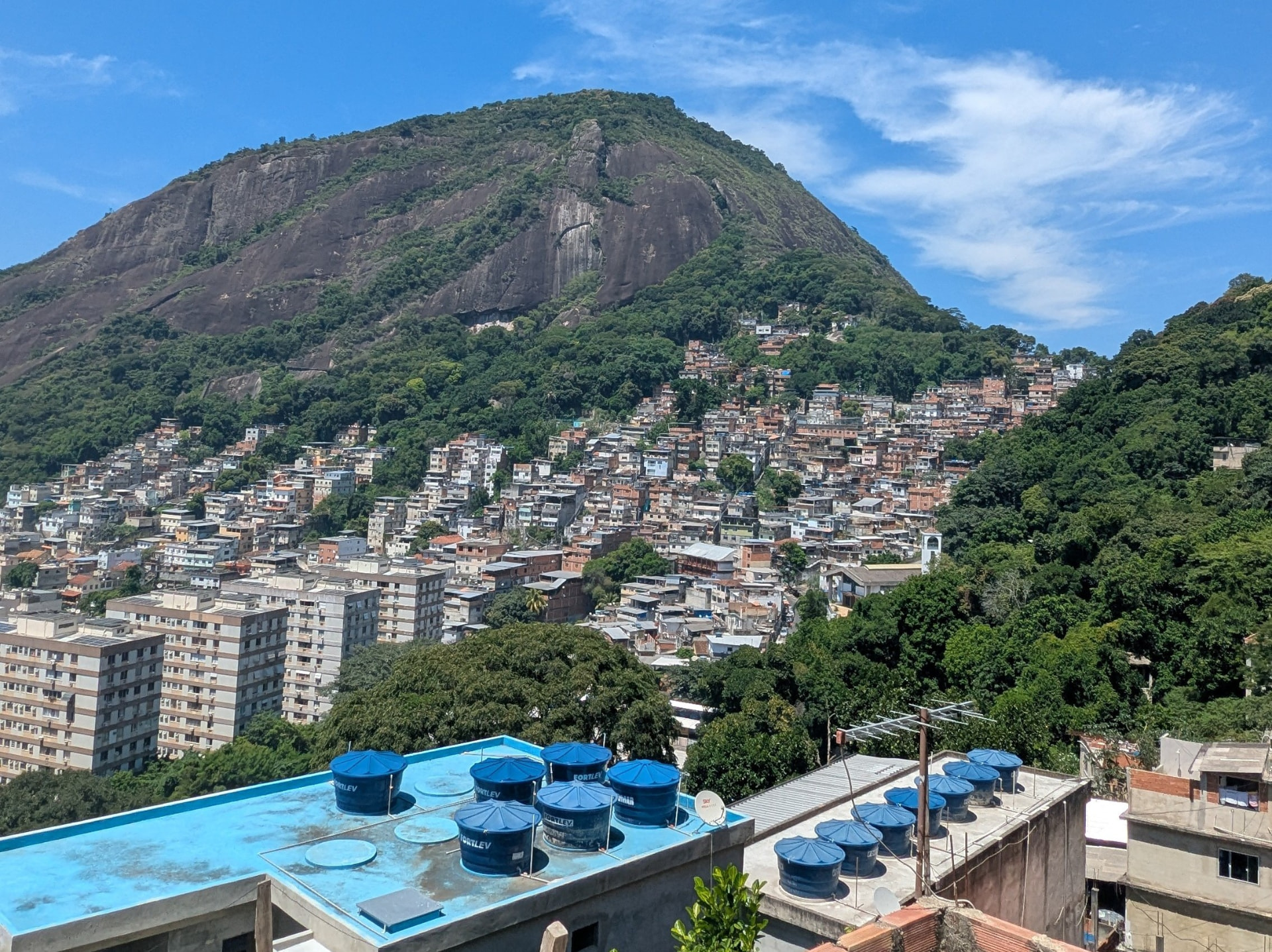
Discover Tabajaras — Authentic Insights Into a Favela Between Copacabana and Botafogo
High above the famous beaches of the Zona Sul, where Copacabana and Botafogo share a single hillside, lies one of Rio's quietest and yet most beautiful communities. Morro dos Tabajaras combines narrow lanes, a lived-in neighbourhood spirit and one of the most spectacular views in the city — taking in the Atlantic, Sugarloaf and Christ the Redeemer in a single sightline. This guide tells you what you should really know before a visit: respectful, practical and free of clichés.
- Location
- Copacabana / Botafogo
- Population
- approx. 5,000
- Founded
- Early 20th century
- Local Peak
- Morro dos Tabajaras
Where is Tabajaras?
Morro dos Tabajaras rises in the heart of the Zona Sul — right where Copacabana meets Botafogo. Coming from Copacabana, you reach the foot of the community via the Ladeira dos Tabajaras, a steep street that climbs from Rua Barata Ribeiro. On the other side of the hill, the view opens toward Botafogo — onto its small bay, Sugarloaf Mountain and the shimmering Guanabara Bay.
Just a few hundred metres away as the crow flies lie two of Brazil's most famous beaches, Copacabana's nightlife and Botafogo's restaurants. And yet Tabajaras itself feels like another world entirely: quiet, close-knit, with a view you would otherwise have to travel far across the city to find.
Proximity to Rua Real Grandeza
On the Botafogo side, the community borders Rua Real Grandeza, a quiet residential street lined with old houses, cafés and bakeries. Several staircases and paths lead up to the hill from here. The opposite Copacabana side is reached via the Ladeira dos Tabajaras and a free public elevator — one of the most convenient access points to any community in Rio.
Transport Links
The metro stations Cardeal Arcoverde (Copacabana) and Botafogo each lie roughly 10–15 minutes' walk from the foot of the community. Numerous bus lines stop on Rua Barata Ribeiro and Rua Voluntários da Pátria. Uber and taxis drive up to the entrances — from there it's on foot, by motorbike taxi, or via the elevator at the Ladeira dos Tabajaras to reach the lanes above.
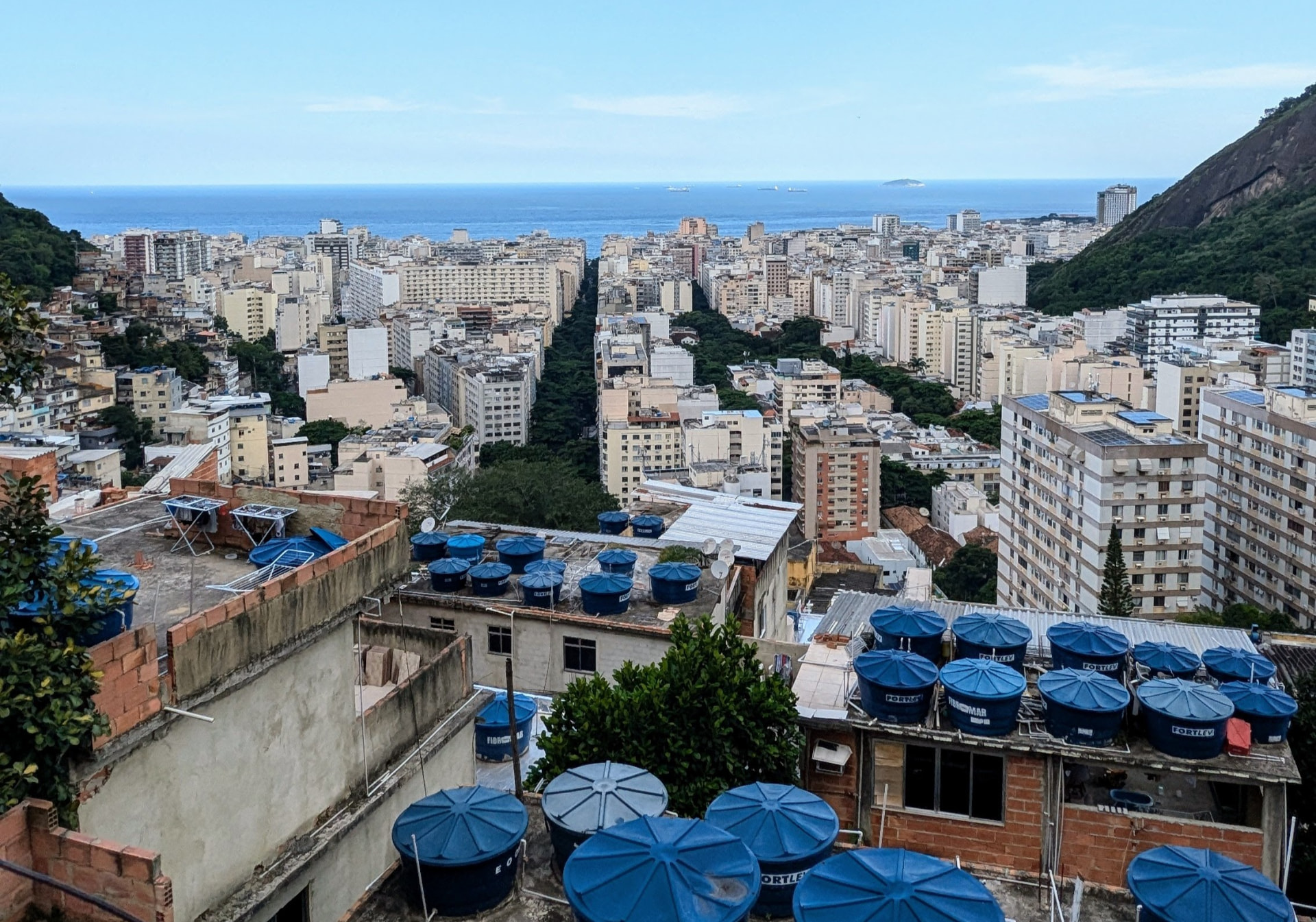
Morro dos Tabajaras · Between Copacabana and Botafogo · Zona Sul
Coordinates: −22.96°, −43.1889°
Placeholder for an interactive map.
Features of the Hillside Setting
Tabajaras is a notably steep community. The hill is threaded with a network of narrow lanes, concrete staircases and slim passageways winding between the houses. Every corner, every landing opens onto a new perspective: at times over the bays of the Zona Sul, at others toward the towering Corcovado with Christ the Redeemer behind it. The elevation also produces a noticeably more pleasant climate — even on hot days, a cool sea breeze blows up here.
The History of Tabajaras
Origins of the Name and Founding
The name Tabajara comes from the Tupi language and refers to one of Brazil's indigenous peoples. The hillside settlement took the name in the early 20th century, when the first residents built shacks on the slope between Copacabana and Botafogo. Like many of Rio's favelas, Tabajaras arose from a combination of housing shortages, rural exodus and the search for work in the booming Zona Sul.
Growth Through Migration
In the 1930s and 1940s, the community grew rapidly. Families from Brazil's Northeast, construction workers, domestic staff, fishermen and musicians found affordable housing in Tabajaras, close to the hotels and villas rising along Copacabana. Proximity to jobs on the coast was a central reason for the steep climb made every morning.
Urbanisation and Consolidation
From the 1960s onward, brick and concrete houses replaced the first wooden structures. Water, electricity and sewage networks emerged first informally, later with public support. Streets were paved, staircases built, houses extended by additional floors. Tabajaras developed into a fixed, formalised neighbourhood with its own postal and address system.
The Public Elevator
A particular milestone was the installation of a public elevator on the Ladeira dos Tabajaras, easing the climb for residents and visitors alike. The free elevator remains in operation to this day and stands as a symbol that infrastructure in Rio's favelas is not a given — but is possible.
Significance Within the Zona Sul
Within the Zona Sul, Tabajaras counts among the mid-sized communities. Less well known than Rocinha or Vidigal, less touristic than Santa Marta, the hill preserves a particular authenticity precisely because of this. For many travellers who want to understand the Zona Sul beyond its postcard images, Tabajaras offers an honest, unhurried introduction to life in Rio's favelas.
Placeholder for an interactive timeline: founding, growth, urbanisation, the elevator, today's community.
Life in Tabajaras
Daily life in Tabajaras starts early. From the first light, bakeries at the foot of the hill open their doors, crates of fruit are stacked outside small shops, and the lanes fill with the sound of radios, coffee cups and children laughing on their way to school. Anyone climbing the hill at this hour sees a community setting itself in motion: commuting employees, tradespeople, vendors — people who keep the rest of the city running every single day.
Neighbourhood and Family Life
The sense of community in Tabajaras is close-knit. Many families have lived on the same hillside for generations, neighbours know each other by name, children play together in the small squares. Much of daily life plays out in public space — on doorsteps, on staircases, at the corner bares.
Local Businesses
The community is sustained by a wide range of small businesses: bakeries, hairdressers, workshops, seamstresses, building-material merchants, mini-markets, phone-credit sellers and electricians. Almost everything needed for daily life can be found within a few minutes' walk. Shopping in Tabajaras directly supports the families on the hill.
Food on the Hill
Small snack stands, bakeries and botequins shape the food scene in Tabajaras. Dishes like feijoada, arroz e feijão with chicken or fish, pastéis and freshly squeezed juices form the standard repertoire. On hot afternoons, the smell of grilled meat drifts out of open-air kitchens.
Schools, Churches, Sport
At the foot and in the lower parts of the community lie several public schools and daycare centres. Churches — both Catholic and evangelical — play an important role in community life, social work and music. Sports fields and improvised pitches are gathering points for children and teenagers; football, volleyball and martial arts such as capoeira and Muay Thai are firmly established.
Music and Culture in Everyday Life
Music is everywhere in Tabajaras. Samba, pagode, funk and forró drift from windows and car speakers. On weekends, individual street corners turn into small stages as a roda de samba spontaneously grows, or a funk DJ sets up their sound system. Anyone who listens respectfully is often warmly invited to stay.
Architecture and Streetscape
The architectural character of Tabajaras is defined by decades of self-built construction and gradual consolidation. Houses have been extended over the years with extra floors, terraces and additions — depending on how each family grew. Coloured façades, corrugated-iron roofs, washing lines strung between houses and flowerpots on narrow balconies define the streetscape.
Lanes and Staircases
The community's path network is dense and functional. Narrow lanes, often only one to two metres wide, connect the houses to each other. On especially steep sections, concrete staircases with hundreds of steps lead up the hill. Anyone who takes on this climb is rewarded at every landing with a new view over Copacabana, Botafogo or the Atlantic.
Difference From Other Favelas
Unlike the vast, urban Rocinha or the world-famous view of Vidigal, Tabajaras is smaller, more compact, and more tightly woven into its surrounding neighbourhoods. The transition from the formal city to the community is fluid in many places — the elevator at the Ladeira is a visible example of this interlocking. This in-between position makes Tabajaras a particularly instructive place to understand how favelas and the "asfalto" interweave in Rio.
Sights
The Public Elevator at Ladeira dos Tabajaras
The free elevator at the lower end of the community is one of the most unusual and practical "sights" in the Zona Sul. It connects Rua Barata Ribeiro with an access point further up the hillside and is used daily by countless residents. For visitors, it offers a convenient way into the community, and it stands as an example of lived urban infrastructure.
Viewing Platforms and Mirantes
Several small viewing platforms line the climb. They are rarely officially marked, but locals happily point them out. From here, the view stretches over Copacabana, Sugarloaf, Corcovado, Botafogo and Guanabara Bay — a panoramic sweep that only a handful of places in Rio can offer.
Graffiti and Street Art
Tabajaras isn't a major street-art destination like Santa Marta or Cantagalo, but many walls carry colourful murals by local artists: portraits of community figures, carnival motifs, political messages. These images frequently emerge from neighbourhood and youth projects.
Small Shops and Workshops
Family-run shops — bakeries, butchers, electronics repair shops, seamstresses — are part of the streetscape. An afternoon walk almost inevitably passes a handful of these businesses. Buying something small or grabbing a juice is a concrete way of supporting the community.
Churches and Community Centres
The hillside is home to several small churches and community rooms where choirs rehearse, children's groups meet and social programmes are organised. They serve as central anchors of social life.
Sports Fields
A central pitch and several small sports areas serve as gathering points for children and teenagers. Football matches in the late afternoon are part of the picture of an ordinary weekday in Tabajaras.
Community Facilities
Neighbourhood associations (associações de moradores), social projects, music programmes and sports initiatives are active in Tabajaras. They organise festivals, look after children, support older residents, and are often the best point of contact for visitors wishing to get to know the community respectfully.
The Best Viewpoints
Tabajaras' greatest treasure is its view. Hardly any other spot in the Zona Sul shows so many of Rio's landmarks at once — and from a height that opens up the view without the crowds you find at Christ the Redeemer.
View of Copacabana
On the eastern side of the hill stretches the famous crescent of Copacabana — four kilometres of white sand, framed by Avenida Atlântica and the blue of the Atlantic. Seen from above, the beach almost looks like a diagram, with the promenade's characteristic wave pattern.
View of Botafogo
On the western side, the view opens onto Botafogo's small, sheltered bay with its sailboats, and behind it the striking rock of Sugarloaf. Especially at low sun, this view becomes one of Rio's most iconic postcard images.
Sugarloaf (Pão de Açúcar)
Sugarloaf lies close by and feels within reach from several points in Tabajaras. If you're lucky, you'll see the cable car gliding between Morro da Urca and Pão de Açúcar across the bay.
Christ the Redeemer
To the west, Corcovado rises above the city with Christ the Redeemer atop it. From Tabajaras, the statue looks small but unmistakable — the view is especially beautiful early in the morning, when mist hangs over the mountain, or in the evening, when its lights switch on.
The Atlantic and the Horizon
To the east, the view opens onto the open Atlantic. On clear days, visibility stretches far into the distance; on cloudy ones, the sea casts a deep, silvery light back into the city.
Guanabara Bay
On the northern side, Guanabara Bay opens up with its islands, the ferries to Niterói and the striking outline of the Rio–Niterói Bridge in the background. This view connects natural landscape and urban infrastructure in a particularly striking way.
Culture and Community
Culture in Tabajaras isn't a stage — it's part of everyday life. Samba, pagode and funk are living traditions, kept alive in living rooms, on pitches and in small bars. They are complemented by capoeira rodas, percussion groups and church choirs.
Bloco Festivals During Carnival
A highlight of the year is the bloco festival during carnival season. Neighbourhood blocos parade through the lower streets, accompanied by drummers and singers; families open their doors, neighbours decorate windows and balconies. The celebration is intimate, open, and far removed from the commercial carnival bustle at the Sambódromo.
Capoeira and Sport
A small but lively capoeira scene trains regularly at one of the upper viewing spots — a striking sight against the backdrop of sea and Sugarloaf. Other martial arts and dance forms such as Zumba and passinho are also offered in small studios or community rooms.
Local Projects
Various social and cultural projects bring together children, teenagers and adults — from music and dance classes to tutoring and environmental and street-cleaning initiatives. Anyone wishing to visit the community respectfully can find contacts to these projects through the Associação de Moradores and local guides.
Events and Traditions
Alongside carnival, smaller festivals shape the year: patron-saint festivals at the churches, children's celebrations on Dia das Crianças, Christmas dinners in community rooms, and New Year's Eve gatherings with a view of the fireworks over Copacabana. These traditions are firmly established and are passed down from generation to generation.
Safety
Tabajaras is among the comparatively quiet communities of the Zona Sul. For visitors, the same principles apply as everywhere in Rio: behave respectfully, stay alert, and seek out current information. The following recommendations help you have a calm and respectful visit.
Recommended Behaviour
- Greet neighbours warmly — a simple "bom dia" opens doors.
- Stick to the main paths and to routes other visitors also use.
- Don't flaunt conspicuous valuables.
- Visit the community preferably in the morning or early afternoon.
- Follow the guidance of residents and guides — they know the current situation best.
Photographing With Respect
Landscape and panoramic photos are usually unproblematic. Please only photograph people, children and private houses with explicit consent. If someone declines, that stands without discussion. Residents are not a backdrop — they live here.
Which Areas Visitors Usually Visit
The lower part of the community, the area around the elevator at the Ladeira dos Tabajaras, the main paths uphill and the well-known viewing platforms are regularly visited by tourists. Areas further up that see less foot traffic should ideally only be visited with a local guide.
A Note on Changing Conditions
The safety situation in Rio's favelas can change at short notice. Before every visit, check with your accommodation, an official tourism office or a local guide about the current situation. This page is no substitute for up-to-date advice.
How to Visit Tabajaras
Guided Tours
For a first visit to Tabajaras, we recommend a guided tour with a local guide. Guides who know the area — often residents themselves — know not only the best viewpoints, but can explain the community's history, daily life and current issues firsthand.
Benefits of a Guided Tour
- Orientation: confident navigation through the winding lanes and staircases.
- History: context on the founding, urbanisation and current situation.
- Local perspectives: encounters with residents, tradespeople and artists.
- Support: a direct contribution to the income of local guides and families.
- Respect: behaviour and photography are handled sensitively from the outset.
Guided tours of Tabajaras will in future be arranged directly through Inside Favela. We work exclusively with local guides rooted in the community. More information is coming soon.
Restaurants and Local Cuisine
The food scene in Tabajaras is down-to-earth, honest and affordable. It's especially worth visiting the small family businesses — here you eat authentic Brazilian food while supporting the community at the same time.
Classic Brazilian Cuisine
Feijoada on Saturdays, arroz e feijão with meat or fish as the daily menu, pastéis, coxinhas and salgados as snacks: the small kitchens at the foot of and in the lower parts of the community serve classic Brazilian everyday dishes at fair prices.
Local Snack Stands and Cafés
Several corners have bakeries serving fresh café com leite, pão de queijo and fruit juices. They are ideal stops between two stages of the climb and a good place to strike up a conversation with residents.
Bars and Botequins
In the evening, the botequins open: small corner bars with cold beer, grilled meat and loud music. They serve as social hubs of the neighbourhood. If you sit down discreetly and order politely, you're often warmly welcomed in.
Sustainable Tourism
A visit to Favela Tabajaras can be a positive force for the community — provided it happens respectfully and responsibly. Sustainable tourism here means above all:
- Respectful conduct: greetings, courtesy, restraint with the camera.
- Supporting local businesses: shop in local stores, eat at local bars and restaurants, book local guides.
- Respecting privacy: no photos into people's homes, no unsolicited portraits, no videos without consent.
- Protecting the environment: take your rubbish with you, don't waste water, stay on the paths.
- Responsible photography: ask people first, never photograph children without a parent's consent, no "poverty porn" imagery.
A visit to Tabajaras is not an "attraction," and the community is not a backdrop. It is home to thousands of people. Anyone who keeps that in mind will experience an intense, honest day in one of Rio's most fascinating corners.
Practical Information
Personal Impressions
This section is deliberately left open — it will be filled in individually after our own visits, making the article unique. Planned additions include:
- · Our own experiences and travel accounts
- · Personal stories from the community
- · Encounters with residents and guides
- · Favourite spots, small cafés, hidden viewpoints
- · Insider tips for a second visit
- · Our own photos from Tabajaras
Interesting Facts About Tabajaras
- Origin of the name: The name Tabajara comes from the Tupi language and refers to one of Brazil's indigenous peoples.
- Two districts, one hill: Tabajaras is one of the few communities in Rio that connects two well-known districts — Copacabana and Botafogo.
- Public elevator: the free elevator at the Ladeira dos Tabajaras is a rare example of public infrastructure integrated directly into a favela.
- 360° panorama: from the upper viewing platforms, Copacabana, Botafogo, Sugarloaf, Christ the Redeemer, the Atlantic and Guanabara Bay are all visible in a single sweep.
- Climate: thanks to the elevation, a cool breeze blows even on humid days — Tabajaras is noticeably more pleasant than the streets down by the sea.
- Local initiatives: neighbourhood associations, sports and music projects shape social life and are open to respectful encounters.
Placeholder for a short video from Tabajaras: the elevator, the lanes, the view, the community.
Placeholder for aerial footage of Tabajaras between Copacabana and Botafogo.
Placeholder for a curated photo gallery from Tabajaras.
Placeholder for accounts from residents, guides and travellers.
Frequently Asked Questions
Is Tabajaras safe for tourists?
Can you visit Tabajaras alone?
How do you get to Tabajaras?
Is a visit to Tabajaras worthwhile?
Do you need a guide?
How long does a visit take?
Can you eat in Tabajaras?
Is photography allowed?
What viewpoints are there?
Does the elevator at the Ladeira dos Tabajaras work?
How does Tabajaras differ from Rocinha or Vidigal?
What makes Tabajaras special?
What should I wear?
Do I need to speak Portuguese?
Can you pay by credit card?
Is there a cash machine in Tabajaras?
When is the best time to visit Tabajaras?
Can you stay overnight in Tabajaras?
Is Tabajaras suitable for children?
Are drone shots allowed?
How can I best support the community?
What should you do in an emergency?
Conclusion
Tabajaras is one of Rio's quietest and yet most beautiful communities. Its position between Copacabana and Botafogo, the spectacular view of Sugarloaf, Christ the Redeemer and the Atlantic, and the tight neighbourhood bond make this hill a special place — beyond the well-known names of Rocinha or Vidigal, but no less striking.
Anyone who visits Tabajaras respectfully discovers a side of Rio you won't find on postcards: a community that has been finding its own way for over a hundred years, with two world-famous neighbourhoods at its feet. A visit here isn't an adventure — it's an honest encounter. And that is exactly why it's worth it.
Other Favelas and Topics
- Babilônia — Rio's Green Balcony Above Leme
- Chapéu Mangueira — the Sister Community in Leme
- Vidigal — Rio's Balcony Over the Atlantic
- Rocinha — the Largest Favela in Latin America
- Santa Marta — Colours, Samba and Michael Jackson
- Cantagalo / Pavão-Pavãozinho — Where the Metro Meets the Hill
- Complexo do Alemão — History and the Cable Car (coming soon)
- History of the Favelas (coming soon)
- Safety in Rio de Janeiro (coming soon)
- Culture of the Favelas (coming soon)
- Favela Tours in Rio (coming soon)