
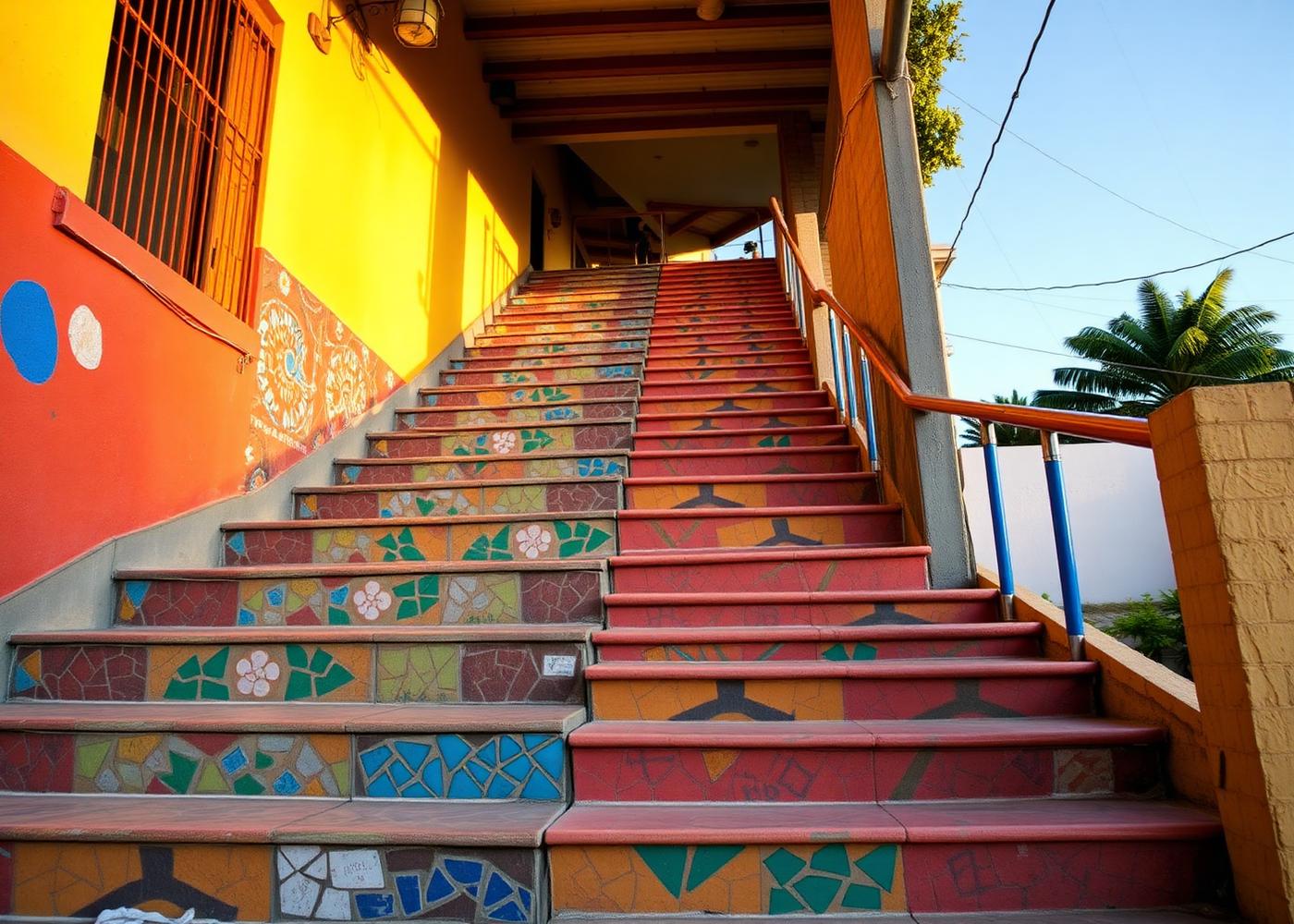
Discovering Santa Marta — History, Culture and Spectacular Views Over Rio
An in-depth guide for a respectful visit to one of Rio de Janeiro's best-known favelas. Between the painted façades of Praça Cantão, the filming locations of Michael Jackson's "They Don't Care About Us," and the sweeping panoramas over Botafogo and Guanabara Bay lies a lively community that is far more than a photo opportunity.
- Location
- Botafogo, Zona Sul
- Residents
- approx. 5,000 (estimate)
- Founded
- 1930s
- Local Peak
- Morro Dona Marta
Santa Marta at a Glance
Santa Marta is a small, densely built favela on the slope of Morro Dona Marta above the neighbourhood of Botafogo in Rio de Janeiro's Zona Sul. The community became world-famous through Michael Jackson's music video "They Don't Care About Us," shot in 1996 together with director Spike Lee, partly on the Praça Cantão. Today Santa Marta is one of Rio's most accessible favelas and a recognised destination for respectful, community-based tourism.
Travellers visit Santa Marta above all to experience the history, culture and everyday life of a Rio favela up close, to see the Michael Jackson statue, and to enjoy the sweeping views over Botafogo, Sugarloaf Mountain and Guanabara Bay. Who should visit: anyone who wants to get to know Rio beyond Copacabana and Ipanema and is willing to engage respectfully with a vibrant neighbourhood.
Where Is Favela Santa Marta?
Santa Marta lies on the steep eastern slope of Morro Dona Marta, directly above Botafogo, one of the most central neighbourhoods of the Zona Sul. The well-known districts of Botafogo, Humaitá, Laranjeiras and Flamengo are within walking distance. From the upper levels of the community, the view stretches across Botafogo Bay, Sugarloaf Mountain, Guanabara Bay and — depending on the viewpoint — as far as Christ the Redeemer on the opposite Corcovado.
The community extends vertically over several levels up the mountain. The classic entry point for visitors is the lower access road around Rua São Clemente and the base station of the Plano Inclinado, a funicular that connects the individual levels. Whether — and to what extent — the funicular is running can change at short notice — check current status before your visit.
Morro Dona Marta · Botafogo · Zona Sul
Coordinates: −22.945°, −43.1917°
Placeholder — will later show access points, paths, viewpoints, the Michael Jackson statue, public squares and selected local businesses.
The History of Santa Marta
The origins of Santa Marta go back to the 1930s. On what was then still largely undeveloped land on the slope of Morro Dona Marta, the first simple houses gradually appeared. Working families from Brazil's Northeast and newcomers from the surrounding region found affordable housing here, close to jobs in Botafogo, Laranjeiras and the city centre. As in many of Rio's favelas, the foundation was self-organisation: houses were built piece by piece through self-help labour and consolidated over decades.
Growth and Urbanisation
In the decades that followed, the community grew significantly. From the 1970s and 1980s onward, brick and concrete buildings replaced the first wooden shacks, houses were extended with extra storeys, and churches, small sports fields, a neighbourhood association and countless family-run businesses appeared. Electricity, water and sewage lines were gradually formalised over the years.
International Attention Through Michael Jackson
In 1996, Santa Marta came into the view of a worldwide audience through the filming of Michael Jackson's music video "They Don't Care About Us," directed by Spike Lee. The images of the colourful houses and the mountainside community have shaped the international image of Rio's favelas ever since.
The UPP Era From 2008
In 2008, Santa Marta became the site of Rio's first so-called Unidade de Polícia Pacificadora (UPP). In the years that followed, the community was regarded as a model project for a new security concept in Rio's favelas. The concrete results of this policy remain controversial to this day — the current security situation can change at any time regardless, and should be checked before any visit.
Praça Cantão and the Colour Project
Also in the late 2000s, a colour project emerged on the Praça Cantão, in which numerous façades were painted together with residents in bold, bright colours across their entire surface. The square has since become one of Santa Marta's most recognisable images and a landmark of the community.
- 1930s — First settlement on Morro Dona Marta
- 1970s–80s — Consolidation, growth, urbanisation
- 1996 — Filming of "They Don't Care About Us"
- 2008 — First UPP in Rio established
- Late 2000s — Praça Cantão colour project
- Today — Community tourism, local guides, cultural projects
An interactive timeline is coming soon.
What Is Life Like in Santa Marta?
Santa Marta is, above all, a place to live. Around the central paths and staircases unfolds an everyday life that resembles that of many other Rio neighbourhoods in many ways: children go to school, adults commute to jobs in Botafogo and beyond, and neighbours meet on weekends to eat, play football or gather for a samba session.
Neighbourhood and Community
The tight spatial layout on the mountainside fosters a strong culture of neighbourliness. People know each other and help each other with construction, shopping and childcare. Public space — stairways, small squares, the forecourts of local bares — is the central hub of social life.
Local Shops and Daily Life
Bakeries, mini-markets, hair salons, workshops, seamstresses, phone shops, juice stands: in Santa Marta you can find almost everything needed for daily life. Visitors who shop here directly support local families.
Education, Religion, Sport
At the foot and on the lower levels of the community are public schools and kindergartens. Alongside Catholic congregations, numerous evangelical churches shape religious life. Football, martial arts, dance and music groups are important gathering points for many young people.
Music, Art and Social Projects
Samba, pagode, funk and rap are part of everyday life. Various neighbourhood and cultural projects work with children and teenagers on music, dance, circus arts, photography and the environment. Specific names, addresses and programmes change frequently — reliable information is best obtained directly on site or through established local guides.
Michael Jackson and Santa Marta
No other place links international pop culture so directly to one of Rio's favelas as Santa Marta. In 1996, Michael Jackson and director Spike Lee filmed parts of the music video for "They Don't Care About Us" from the album HIStory here. Part of the footage was shot in the historic centre of Salvador da Bahia, another part on and around the Praça Cantão in Santa Marta.
What the Shoot Means for the Community
For Santa Marta, the shoot was more than just an event: the images gave the community worldwide visibility — in a way that residents themselves describe as dignified and strong. To this day, the connection to Michael Jackson remains an essential part of local identity and an important element of respectful community tourism.
The Michael Jackson Statue
At the spot where Michael Jackson was filmed on the Praça Cantão, there now stands a life-size bronze statue by sculptor Nilton Campolino, complemented by a large mosaic wall depicting scenes from the music video. The site draws visitors from around the world while continuing to serve as a public square for the community.
Significance for Tourism Today
The Michael Jackson connection makes Santa Marta one of Rio's best-known favela destinations. For the community, it is both an opportunity and a responsibility: it brings attention and income, but also demands that visits remain respectful and do not slide into sensationalist tourism.
Placeholder for an original photo of Nilton Campolino's bronze statue and the mosaic wall on the Praça Cantão.
A short video feature about the Praça Cantão, the statue and the surrounding community — coming soon.
Sights in Santa Marta
Iconic monument at the original filming location of the music video, surrounded by a large mosaic wall.
- Location:
- Praça Cantão, mid-level of the community
- Visitor tip:
- Quiet time for photos: early morning or late afternoon.
Painted façade project with entire houses colour-blocked; a visual landmark of Santa Marta.
- Location:
- Mid-level, directly above the statue
- Visitor tip:
- Greet residents, and avoid photographing into open windows or doorways.
Sweeping panoramas over Botafogo, Sugarloaf Mountain, Guanabara Bay and — depending on the spot — Christ the Redeemer.
- Location:
- Upper levels along the hillside
- Visitor tip:
- Sunrise and sunset offer soft light — check visibility beforehand.
Murals by local artists between the Praça Cantão and the upper levels.
- Location:
- Scattered along the paths and staircases
- Visitor tip:
- Visit with a local guide who knows the backstories and the artists.
A characteristic network of narrow passages, concrete stairs and intermediate squares.
- Location:
- Between the community's various levels
- Visitor tip:
- Wear sturdy shoes, and greet residents politely when passing.
Neighbourhood projects focused on music, dance, sport and the environment.
- Location:
- Various locations within the community
- Visitor tip:
- Ask local guides about current programmes — offerings change often.
The Best Viewpoints
Santa Marta ranks among the favelas with some of the most intense views in Rio. Climbing the mountain or taking the funicular (check operation beforehand), you see more of the city with every metre of elevation. From the upper viewpoints — depending on the exact vantage point — visible sights include:
- Botafogo and the crescent-shaped Botafogo Bay
- Sugarloaf Mountain (Pão de Açúcar) on the Urca peninsula
- The vast Guanabara Bay with ferry traffic and Niterói's skyline
- Surrounding neighbourhoods such as Humaitá, Laranjeiras and Flamengo
- From suitable angles, Christ the Redeemer atop Corcovado
Not every viewpoint shows all of these sights — it depends on elevation, orientation and local sightlines. Local guides know the best perspectives and where photos and views are particularly rewarding.
Placeholder for a curated photo gallery of views from Santa Marta — coming soon with original photography.
Street Art, Music and Culture
Santa Marta is a visually and musically vibrant place. Alongside the colour project on the Praça Cantão, numerous murals and graffiti shape the streetscape. Motifs range from portraits of local figures to political messages and references to music, Carnival and Afro-Brazilian culture.
Musically, the community is strongly shaped by samba, pagode and funk. On weekends, spontaneous sessions can spring up in bars and on small squares. Whether and exactly when such events happen is rarely predictable — those who show up open and respectful are usually welcomed warmly.
How to Get to Santa Marta
Getting Around Within the Favela
Santa Marta is an extremely steep community. Narrow alleys, concrete stairs and tight passages connect the various levels. People with limited mobility should plan their visit carefully; the funicular can ease part of the climb but does not replace a barrier-free route.
Santa Marta on Your Own or With a Guide?
Both approaches are fundamentally possible. Which one suits you better depends on experience, language, time and personal interests.
| Criterion | On Your Own | With a Local Guide |
|---|---|---|
| Orientation | Possible with a map app | Very good, knows every level |
| Cultural context | Limited | Comprehensive, first-hand |
| History | From research | Told from a resident's perspective |
| Contact with the community | Random | Mediated, respectful encounters |
| Flexibility | High | Bound to the tour |
| Cost | Low | Fair, supports local income |
| Safety | Requires your own judgement | Current situation known on the ground |
| Local economy | Only if consumed consciously | Directly through the tour and recommendations |
A guide is not strictly necessary — but for a first visit it is clearly recommended. Anyone already familiar with Rio, who speaks Portuguese and feels confident moving through communities, can generally visit Santa Marta independently as well.
Guided Santa Marta Tours
When choosing a tour, it pays to look closely. Offerings worth recommending meet the following criteria:
- Local guides from Santa Marta or neighbouring communities.
- Small groups that don't overburden paths and neighbours.
- Respectful photo rules: no portraits of children, no photos inside houses.
- No "slum safari" mentality — no staging of poverty.
- Transparent pricing and clearly communicated services.
- Local value creation: payments flow back into the community.
Explore Santa Marta With a Local Guide
Inside Favela is working on selected tours with local guides in Santa Marta. More information will follow.
- Duration: —
- Language: —
- Group size: —
- Price: —
- Guide: —
- Rating: —
- Availability: —
- Duration: —
- Language: —
- Group size: —
- Price: —
- Guide: —
- Rating: —
- Availability: —
Safety in Santa Marta
Santa Marta is among the favelas regularly entered by visitors respectfully and without particular incident. At the same time, one thing holds true: the security situation in Rio — and specifically in individual communities — can change at short notice. This page is no substitute for day-of advice.
Is Santa Marta Safe for Tourists?
A blanket statement like "Santa Marta is safe" would be irresponsible. It is more accurate to say: a respectful visit to the well-known areas is, under normal conditions, regularly possible without particular incident. In exceptional situations — police operations, armed confrontations or similar events — no tourist visit should take place.
Can You Visit Santa Marta Alone?
Generally yes, especially the accessible areas around the Praça Cantão and the Michael Jackson statue. For a first visit, for more remote levels, and whenever in doubt, a local guide is the better choice.
When Should a Visit Be Avoided?
- During ongoing police operations or reports of conflict in the community
- At night, if you don't know the area
- During heavy rain (slippery stairs, landslide risk on certain slopes)
- If your accommodation or a local guide explicitly advises against it
Rules of Conduct
- Greet people politely, dress unobtrusively, don't display valuables
- Take instructions from guides or residents seriously
- No photos of police forces, vehicles or presumably sensitive areas
- Show no curiosity toward possible criminal structures — not a topic for conversation with strangers
- Turn back if in doubt — nobody will hold it against you
Photography in Santa Marta
Basic principle: photograph places — photograph people only with respect and consent.
- Don't photograph people up close without asking
- Protect children in particular — never without a parent's consent
- Respect private homes and interiors — no photos through open doors
- Don't stage poverty as a photo motif, no "poverty porn"
- If in doubt, simply ask politely; a "no" is a no
- Drone flights over inhabited areas only with local agreement and legal clearance
Food and Drink
Local gastronomy in Santa Marta is simple, honest and affordable: small family-run businesses, bakeries, botequins, snack bars. Typical dishes range from arroz e feijão with meat or fish, to pastéis and coxinhas, to a classic feijoada on weekends. Specific names and opening hours change often — we deliberately avoid making up recommendations. Local guides or neighbours can help with current tips.
- Category: —
- Description: —
- Location: —
- Price range: —
- Category: —
- Description: —
- Location: —
- Price range: —
How Much Time Should You Plan?
These time estimates are our editorial recommendations — individual pace and interests can change them considerably.
Best Time to Visit
- Time of day: morning and early afternoon — light is soft, visibility is usually best.
- Weather: April to October is drier; November to March is humid with more frequent showers.
- Heat: the climb is steep — hot afternoons are strenuous.
- Rain: stairs become slippery; postpone your visit during heavy rain.
- Weekends vs. weekdays: quieter on weekdays, more community life on squares and in bars at weekends.
Safety cannot be read from the time of day — visiting at night is generally not advisable for outsiders, but even during the day: gather current information beforehand.
What Should You Bring?
- Comfortable, sturdy shoes with good tread (stairs, uneven paths)
- Plenty of water
- Sun protection: hat, sunscreen, sunglasses
- Light, breathable clothing
- Smartphone and power bank
- A small reserve of cash in BRL (Pix is useful too)
- A copy/photo of your passport and your accommodation's address
Important: Santa Marta sits on a steep hillside. Anyone who isn't comfortable with heights or has significant physical limitations should adjust their route and pace accordingly, and plan a shorter visit if in doubt.
Respectful Favela Tourism
A favela is not an open-air museum. People live here, work here, raise their children here. A visit to Santa Marta can be a positive impulse for the community — when it happens respectfully.
- Respect residents, greet them, don't stare
- Support local businesses — shop and eat there wherever possible
- Book local guides rather than large, detached operators
- Photograph respectfully, see the dedicated chapter
- Leave no trash, don't leave the designated paths
- Respect privacy, don't enter houses uninvited
- Neither romanticise poverty nor sensationalise it
- No social media content that mocks or endangers the community
Inside Santa Marta
In this section, we will publish personal stories, interviews and portraits from the community. The goal is to make visible the people who make Santa Marta what it is — residents, artists, entrepreneurs, guides and social projects.
Interview and photo coming soon.
Interview and photo coming soon.
Interview and photo coming soon.
Interview and photo coming soon.
Interview and photo coming soon.
Interview and photo coming soon.
Santa Marta in Comparison
| Favela | Location | Character | Renown | View | Duration |
|---|---|---|---|---|---|
| Santa Marta | Botafogo | Colourful, compact, Michael Jackson | Very high | Sugarloaf, Botafogo, bay | 2–4 h |
| Vidigal | Leblon / São Conrado | Creative scene, music, views | High | Ipanema, sea, Dois Irmãos | 3–6 h |
| Rocinha | São Conrado / Gávea | Largest favela, city within a city | Very high | Only from certain points | 3–5 h |
| Tabajaras | Copacabana / Botafogo | Quiet, family-oriented, public lift | Medium | Sugarloaf, Christ, Copacabana | 2–4 h |
| Babilônia & Chapéu Mangueira | Leme | Nature, hikes, community | Medium | Copacabana, Leme, Guanabara | 3–5 h |
| Cantagalo / Pavão-Pavãozinho | Copacabana / Ipanema | Metro access, street art | High | Ipanema, Copacabana, sea | 2–4 h |
This overview compares useful touristic criteria — not a ranking by danger or safety.
Discover More Favelas
FAQ — Visiting Santa Marta
Is Santa Marta worth visiting?
Is Santa Marta safe?
Can you visit Santa Marta alone?
Do you need a guide?
How do you get to Santa Marta?
How much time should you plan?
Where is the Michael Jackson statue located?
Why did Michael Jackson film in Santa Marta?
Can you eat in Santa Marta?
Is photography allowed in Santa Marta?
Can you take an Uber to Santa Marta?
What shoes should you wear?
Is Santa Marta suitable for children?
How strenuous is the visit?
What views does Santa Marta offer?
When is the best time to visit?
What does a guided tour cost?
Can you combine Santa Marta with other sights?
What other favelas can you visit in Rio?
How do you support the local community during a visit?
Does the funicular (Plano Inclinado) in Santa Marta work?
Can you stay overnight in Santa Marta?
Is Santa Marta recommended in the rain?
Conclusion
Santa Marta is neither the "colourful postcard motif" to which it is sometimes reduced, nor the dangerous place that some travel blogs stage it as. It is, first and foremost, a lively neighbourhood on the slope of Morro Dona Marta — with an eventful history, a strong community, and a distinctive international visibility thanks to Michael Jackson.
Anyone who visits Santa Marta respectfully and takes an interest in its history, people and culture can get to know a side of Rio de Janeiro that goes far beyond the well-known beaches and sights. That is precisely where the value of such a visit lies.
Sources & Further Information
This article is based on editorial research, publicly available information on the history of Santa Marta, and conversations with local contacts. Where information can change at short notice (safety, transport, the funicular, prices, opening hours, tour operators), we deliberately avoid specific figures and instead recommend gathering current information immediately before your visit.
Other Favelas and Topics
- All Favelas on Inside Favela
- Tabajaras — Favela Between Copacabana and Botafogo
- Vidigal — Rio's Balcony Over the Atlantic
- Rocinha — Latin America's Largest Favela
- Babilônia — Green Balcony Over Leme
- Chapéu Mangueira — Sister Community in Leme
- Cantagalo / Pavão-Pavãozinho — Where the Metro Meets the Hill
- Safety in Rio's Favelas (guide coming soon)
- Favela Tours in Rio (guide coming soon)
- Culture of the Favelas (coming soon)
- History of the Favelas (coming soon)