
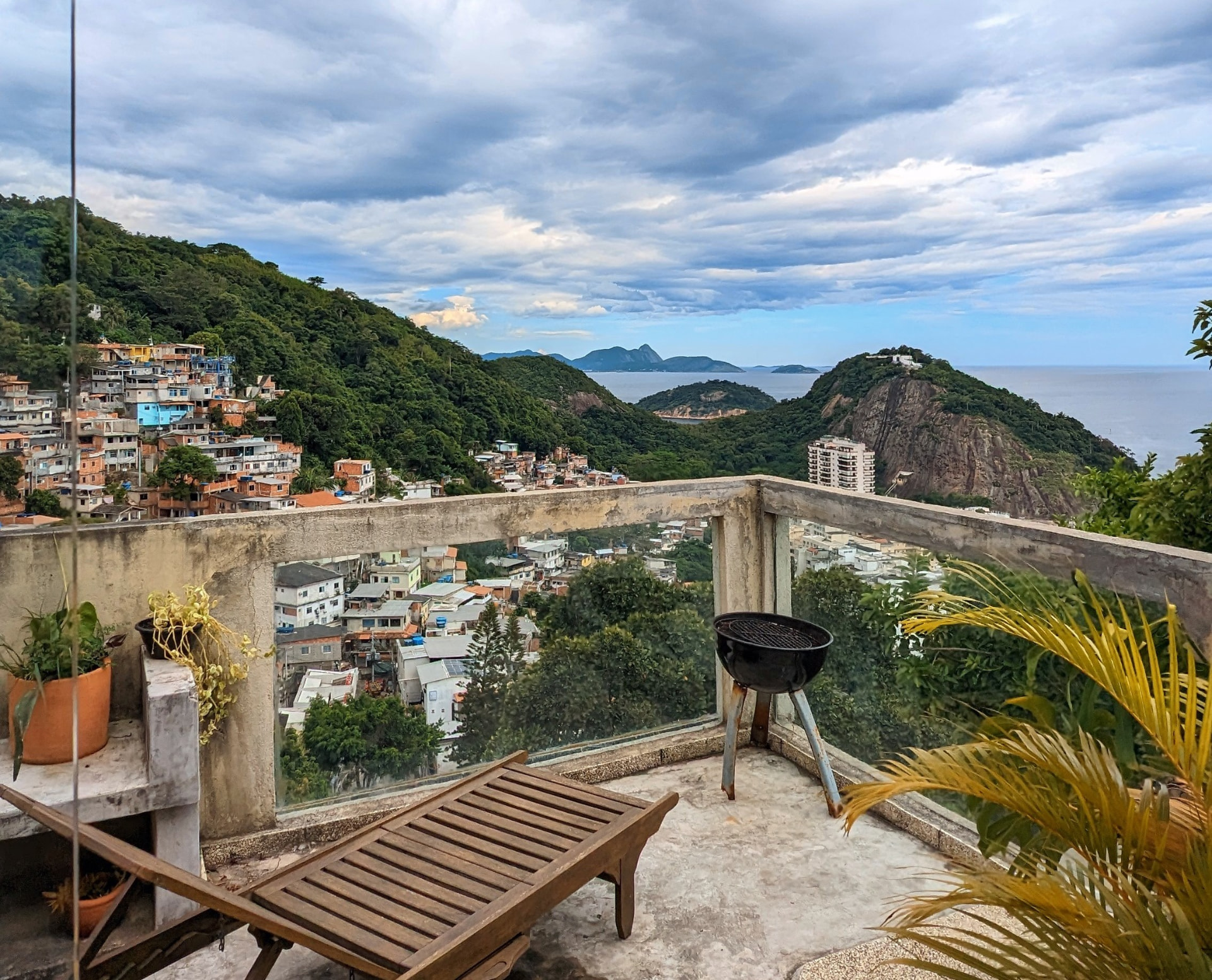
Favela Babilônia — Rio's Green Balcony Above Leme and Copacabana
Between the Atlantic, the Sugarloaf and one of the last remaining stretches of urban rainforest in the Zona Sul lies one of Rio's most beautiful, and yet lesser-known, communities. Babilônia combines steep lanes, a strong sense of neighbourhood and spectacular panoramas with a richness that has become rare: its own piece of Mata Atlântica right on its doorstep. This guide tells you what you should really know before a visit — respectful, practical and free of clichés.
- Location
- Leme, Zona Sul
- Population
- ~ 4,000
- Founded
- Early 20th century
- Local Peak
- Morro da Babilônia
Where is Babilônia?
Babilônia lies on the eastern edge of the Zona Sul, above the district of Leme, the quieter stretch where Copacabana tapers off towards the Fort Duque de Caxias. Walking north along the broad promenade of the Avenida Atlântica, you can clearly see the hill rising ahead: greener than its neighbours, with houses nestled gently into the vegetation.
The community shares a mountain with its sister neighbourhood Chapéu Mangueira and is bordered on the other side by one of the city centre's most exciting natural areas: the Parque Estadual da Chacrinha and the protected hillside stretches of the Mata Atlântica. Just a few hundred metres away as the crow flies stand Morro da Urca and the Sugarloaf. The proximity to this landmark shapes every view from up here.
Getting Around
From the foot of the hill, it's only a few minutes to the Praça Almirante Júlio de Noronha in Leme, the terminus of numerous bus lines. The nearest metro station, Cardeal Arcoverde in Copacabana, is around a 20-minute walk away. Uber and taxis reliably reach the access point of the community — from there, it's traditionally on foot or by motorbike taxi up into the lanes.
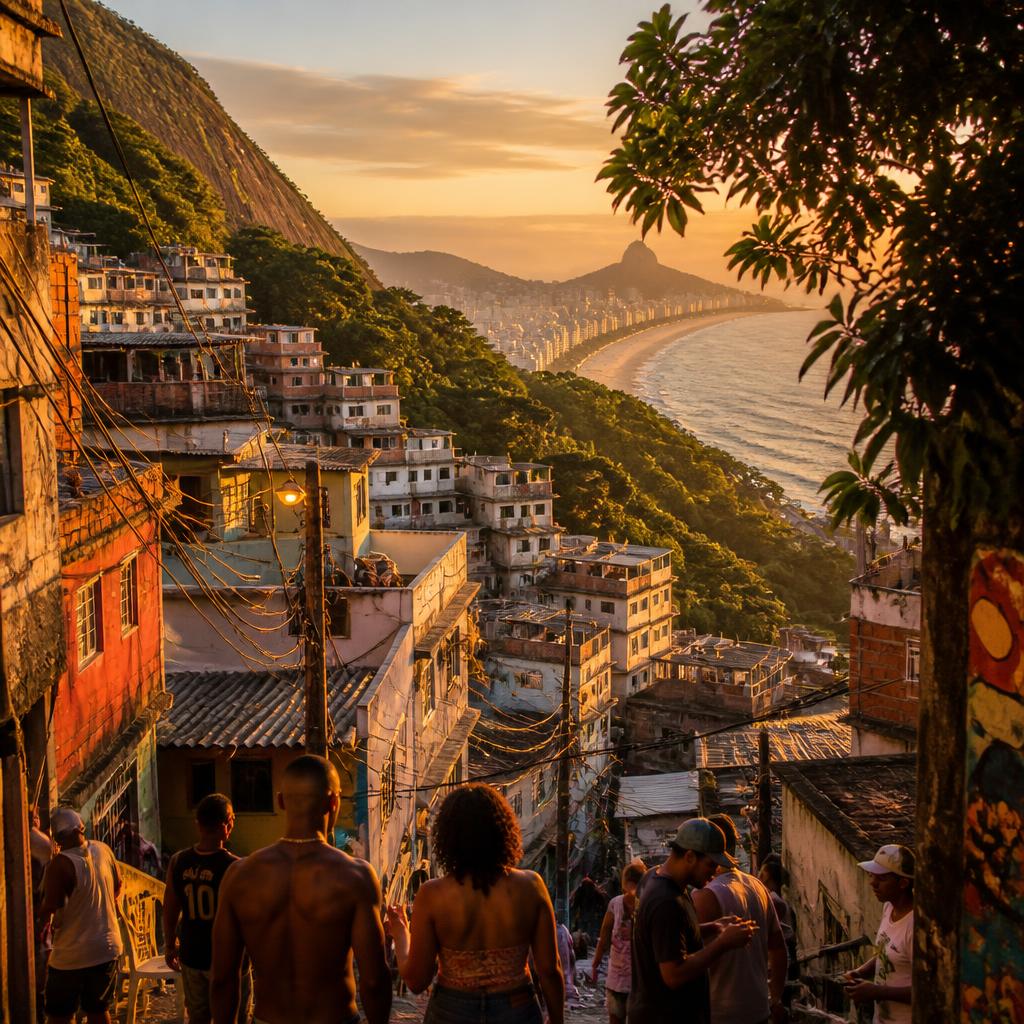
Babilônia, Leme · Zona Sul · Rio de Janeiro
Coordinates: −22.9606°, −43.175°
Placeholder for an interactive map.
Distinctive Features of the Location
Hardly any other favela in Rio sits so directly against a nature reserve. The transition from residential lane to rainforest often happens within a few steps: right behind the last house, the green hillside begins. At the same time, despite its proximity to Copacabana, Babilônia is remarkably quiet — it lacks the busy thoroughfares that cut through many other communities.
The History of Babilônia
Origins in the Early 20th Century
Babilônia is among Rio's oldest favelas. As early as the 1900s, soldiers who returned to the capital without permanent housing after the War of Canudos built makeshift huts on the hillside. According to tradition, the name Babilônia comes from one of these returnees, who compared the diversity of the people on the hill to the biblical image of multilingual Babylon.
Growth and Urbanisation
Over the following decades, the community grew with the waves of migration from Brazil's Northeast. Fishermen, construction workers, domestic staff and musicians found affordable housing within walking distance of the hotels and villas then springing up in Copacabana. From the 1950s, brick and concrete houses replaced the first wooden structures, and water and electricity networks emerged — informally at first, later with public support.
Cinema, Culture and Worldwide Visibility
In 1959, the French film Black Orpheus (Orfeu Negro) by Marcel Camus made the community internationally known: many scenes of the Oscar-winning film were shot in the lanes of Babilônia. The film conveyed a romanticised image, but it also brought new attention to favela culture — in particular to samba, long cultivated in the community's rodas.
Community and Self-Organisation
Babilônia is still regarded today as a community with an especially strong sense of togetherness. The Associação de Moradores (residents' association) has organised neighbourhood affairs for decades — from infrastructure issues to cultural festivals. Several cooperatives run reforestation and environmental projects, for which the community has already received international recognition.
Significance Within the Zona Sul
In a zone where property prices have risen for decades, Babilônia and Chapéu Mangueira are important anchors of a socially mixed city centre. They serve as a reminder that the economy of Copacabana and Leme — from hotels to street kiosks — could not function without the people of the surrounding communities.
Placeholder for an interactive timeline of Babilônia's history: from the first huts in the early 20th century, through Black Orpheus, to the reforestation projects of recent years.
Life in Babilônia
Everyday Life on the Hillside
The day begins early and quietly in Babilônia. In front of the small padarias, the first neighbours gather for a cafezinho, children in their school uniforms head down towards Leme, and motorbikes putter up the narrow streets. Anyone who takes their time will hear more birdsong than traffic in the morning — a rare combination in a city of two million.
Neighbourhood and Community
With around four thousand residents, Babilônia is considerably smaller than Rocinha or Vidigal. People know each other, greet each other, help each other. The residents' association organises festivals, looks after children's and youth projects, and serves as a central point of contact both for residents and for visitors seeking respectful contact.
Gastronomy and Local Businesses
Alongside classic botequins, a few notable addresses have established themselves in recent years: the restaurant Estrelas da Babilônia with its view over Leme, the community café Bar do David, repeatedly praised for its feijoada, and small kitchens serving traditional Northeastern dishes such as baião de dois or moqueca.


Art, Music and Culture
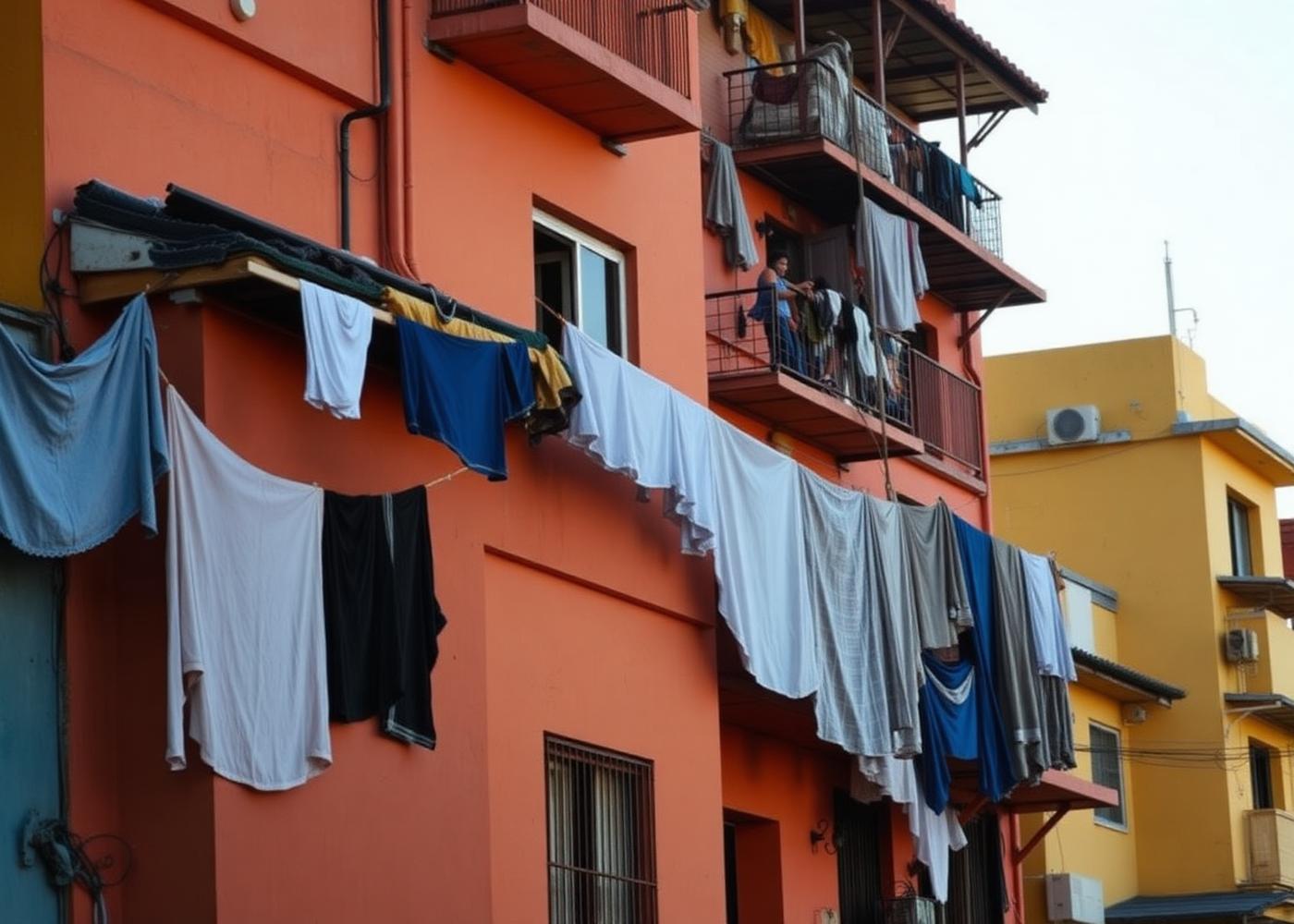
Babilônia has a special relationship with samba. Well-known instrumentalists, singers and composers have come from the community, and still do. On weekends, rodas de samba form in small bars and on neighbourhood squares, open to everyone — as long as you listen respectfully, join in the singing, and don't just film.
Sustainable Initiatives
Hardly any favela has as many environmental and educational projects packed into such a small area as Babilônia. From the recycling collective to the reforestation team, from the community radio station to the children's art project: much of it is carried by the neighbourhood itself. That is precisely what makes the community a model for sustainable urban tourism in Rio.
Nature and Environment
Babilônia sits within a unique natural setting. The entire hillside belongs to the remaining stock of the Mata Atlântica — the tropical coastal rainforest that once covered the entire Brazilian coast and today survives only in fragments. The neighbourhood is home to capuchin monkeys, sloths, toucans, hummingbirds and numerous endemic tree and plant species.
Community-Led Reforestation
As early as the 2000s, residents began, under the name Cooperativa dos Guias e Reflorestadores da Babilônia, replanting degraded hillside areas with native tree species. Tens of thousands of saplings have since been planted — a project that not only stabilises the hillside but also creates jobs within the community.
Parque Estadual da Chacrinha
Directly bordering Babilônia is the Parque Estadual da Chacrinha, a state-protected nature park. Trails, small viewpoints and information points invite a gentle encounter with the Mata Atlântica. The park is usually open to visitors Tuesday to Sunday; the entrance is within walking distance of the community.
The Importance of Conservation
The hillside above Leme is one of the last green buffers in the Zona Sul. It stores water, cools the city, captures CO2 and provides habitat for numerous species. The community's protection of this forest is a quiet but far-reaching achievement — and one reason why a visit to Babilônia is also a visit to Rio's nature.
Sights in Babilônia
Mirante do Leme
The Mirante do Leme is the community's best-known viewpoint. From a narrow platform on the upper hillside, the view stretches over Leme beach and the entire bay of Copacabana, past the Sugarloaf and out to the Atlantic. On clear days, you can even make out the silhouette of Christ the Redeemer.
Eco Trail Babilônia
The Eco Trail Babilônia is a nature path laid out by the community, running through the reforestation areas and remnants of the Mata Atlântica. The trail is signposted, with markers explaining key tree and plant species. It is usually walked with local guides who are part of the Reflorestadores cooperative — so a visit directly supports the conservation project.
Morro da Babilônia
The mountain that gives the community its name is itself a sight worth seeing. The old ruins of the military Fortificação da Babilônia from the Second World War sit halfway up in the forest and can be visited as part of a guided hike. From the top, you enjoy one of the quietest panoramic views in the city.
Street Art and Local Squares
Along many façades on the way up you'll find murais by local artists: portraits of community figures, natural motifs, Afro-Brazilian symbols. Small squares, such as the central praça in the middle of the community, are social meeting points — chess games, music, neighbourhood chats.
Historic Areas
Anyone interested in history will find some of the community's oldest houses in the lower area — simple, brightly painted buildings that tell the story of the first phase of settlement. The transition between Babilônia and Chapéu Mangueira is also worth a walk: here, two communities merge into a shared neighbourhood.
Hike to Mirante do Leme
The hike to the Mirante do Leme and onward along the Eco Trail to the Morro da Babilônia is one of Rio's most rewarding short hikes. It is considerably less demanding than the climb to Dois Irmãos in Vidigal — but at least as scenic.
Route and Course
The starting point lies at the upper edge of the community. From there, a well-marked path first runs flat through the reforestation areas, then climbs in gentle switchbacks. After about 20 minutes you reach the first viewpoint; after 40 to 60 minutes, the old military ruins and the upper plateau.
Difficulty and Duration
The hike is considered easy to moderate. The path is unpaved but easy to walk. Sturdy shoes with good tread are a good idea; specialised mountain gear is not needed. Allow two to three hours for the round trip, including breaks.
Best Time of Day
The trail is most beautiful in the early morning, when the sun is still low and the air is clear. Late afternoon is also impressive — but be sure to be back down before dark. Avoid rainy days: the paths become slippery quickly.
Tips for Visitors
- Bring at least 1.5 litres of water — there are no kiosks up top.
- Use sun protection and insect repellent.
- Stick to marked paths, don't take shortcuts — the forest is sensitive.
- If possible, go with a local guide from the Reflorestadores cooperative.
- Leave no litter behind — not even banana peels or tissues.
Art and Culture
For its size, Babilônia has an impressively dense cultural scene. Alongside the established rodas de samba and street-art works, there are numerous initiatives that see art as a tool for education, self-confidence and community work.
Street Art
Façades, staircases and walls in Babilônia form an open gallery. Many motifs draw on the community's history, others engage with environmental or social themes. Anyone wanting to understand the works in context is well advised to take a guided street-art tour.
Music and Samba
Samba has shaped Babilônia since its earliest decades. Traditional rodas — open circles with cavaquinho, pandeiro and singing — take place regularly. Choro and modern samba-rock also have roots in the community.
Community Projects
The community's cultural centre offers courses in music, dance, photography and environmental education. Many projects are led by residents themselves. For visitors, a short stop here is often one of the most honest encounters of the whole day.
Events
The annual environmental festival, Carnival blocos such as the local one in February, open-air film screenings and samba evenings give the year in Babilônia its rhythm. Current dates are shared by the community and local guides via social media.
Safety in Babilônia
Safety is the topic that concerns many travellers most before a favela visit. We treat it factually. Babilônia is an inhabited community — not a backdrop, not a restricted zone. As in any city, there are local rules that visitors should respect.
Which Areas Visitors Usually Visit
Most visits focus on the lower and middle parts of the community, the access to the Eco Trail, the Mirante do Leme, and the established restaurants and cafés. Anyone wanting to explore further side lanes should do so with local company.
Recommended Behaviour
- Greet people warmly — a "bom dia" or "boa tarde" opens doors.
- Carry valuables discreetly, and leave expensive jewellery and large cameras at your hotel.
- Photograph people, children and private houses only with explicit consent.
- Follow the guidance of local guides or residents on which paths are best avoided.
- Move about as a guest, not an observer — curiosity is welcome, distance is not.
Photography and Respect
Landscape and panoramic shots are usually unproblematic. Close-up photos of houses, shops or people call for asking first. If someone doesn't want to be photographed, that must be respected without discussion.
Note: the safety situation in Rio de Janeiro can change at short notice. Before visiting, inform yourself of current local advice, follow the recommendations of your accommodation or guide, and observe official travel warnings. A forthcoming feature on Inside Favela on "Safety in Rio de Janeiro" will summarise ongoing developments.
How to Visit Babilônia
Almost every visit begins at the Praça Almirante Júlio de Noronha in Leme, just a few metres from the beach of the same name. From there, short streets and staircases lead into the community.
From Leme beach, it's only a few minutes to the foot of the community. The climb itself is steep but manageable. Most pleasant in the morning.
A guided tour combines transport, translation, history and access to the Eco Trail. Ideal for a first visit.
Rides usually end at the praça in Leme or at the lower access point. Reliable, affordable, ideal for less confident walkers.
Numerous bus lines terminate in Leme; the Cardeal Arcoverde metro station is 20 minutes away. Very cheap, an everyday experience.
Independent or With a Guide?
For a first encounter with Babilônia, we recommend a guided tour, especially if you also want to walk the Eco Trail or climb the Morro da Babilônia. Anyone who already knows Rio, speaks a few words of Portuguese and only wants to see the lower areas plus a selected viewpoint can also do this independently during the day.
Guided Tours
A good guided tour turns a visit to Babilônia into far more than a stop at a viewpoint. Local guides — often residents themselves — explain the community's history, lead the way to the reforestation areas, open doors to small studios and cafés, and translate conversations on the ground.
Typical Benefits of a Good Tour
- Orientation in a neighbourhood without conventional street signs.
- Local history and stories you won't find online.
- Nature: access to the Eco Trail with expert explanation.
- Culture: contact with musicians, artists and community projects.
- Direct support for local guides and cooperatives.
Guided tours will in future be offered directly via Inside Favela. We are currently working with local guides to make fair and respectful offerings transparently bookable. Once the system is live, you'll find the corresponding booking link here.
Restaurants and Cafés
A small, subjective selection of typical addresses in and around Babilônia:
- Bar do David — a repeatedly praised botequim, known for its feijoada and lovingly reinterpreted classic Brazilian cooking.
- Estrelas da Babilônia — a restaurant with a terrace and sweeping views over Leme, a good address for a relaxed dinner.
- Community cafés in the upper area — small, family-run kitchens serving typical dishes from Brazil's Northeast.
- Padarias in Leme — for the start of the day: pão de queijo, café com leite and fresh juices.
- Kiosks on Leme beach — after the hike: água de coco straight from the shell, with a view of the sea.
Opening hours and offerings may change. If in doubt, ask your accommodation or guide for current recommendations.
The Finest Viewpoints
Babilônia offers some of the most beautiful, and quietest, views in the Zona Sul:
- Mirante do Leme — the classic postcard view over Leme, Copacabana and the Atlantic.
- Upper plateau of the Morro da Babilônia — a 360° view over the Sugarloaf, Guanabara Bay, the Atlantic and, in the distance, Christ the Redeemer.
- Ruins of the old Fortificação — a historic spot with a spectacular view of the Sugarloaf, hidden in the forest.
- Small terraces along the climb — often surprising, lesser-known perspectives on Leme and the bay.
Sustainable Tourism
Babilônia is one of the places in Rio where sustainable tourism is not a marketing phrase. Every visit has a direct effect — on the people, the forest and the culture.
- Support local businesses: eat at community restaurants, buy directly from craftspeople and artists, use guides from the neighbourhood.
- Protect the environment: stay on marked paths, don't pick plants, don't feed animals, bring your own water bottle.
- Avoid litter: take packaging back with you — waste collection does not reach every lane, and certainly not the forest.
- Respect privacy: no photos of people, houses or children without consent. Don't post recognisable images without checking first.
- Travel responsibly: choose operators who work transparently with the community and with conservation efforts.
Practical Information
- Best Time to Visit
- April to October (drier months). Mornings are most pleasant; the sun is intense year-round.
- Recommended Duration
- 2 to 3 hours for a first impression. With the Eco Trail and hike, allow half a day.
- Clothing
- Comfortable, sturdy shoes with good tread, breathable clothing, sun hat, sunscreen. Long, lightweight trousers are recommended for the trail.
- Payment
- Many small shops accept only cash (Real, BRL) or Pix. Bring exact change where possible.
- Internet and Phone
- Mobile networks are generally stable, with Wi-Fi in cafés and accommodation. A Brazilian SIM or eSIM is handy.
- Language
- Portuguese. English occasionally, German rarely. A few polite phrases are much appreciated.
- Weather
- Tropical. Warm year-round; hot and humid in summer (December to March), with occasional afternoon showers.
- Chacrinha Park Opening Hours
- Usually Tuesday to Sunday, morning to afternoon. Check the exact times on site.
All details are provided without guarantee — opening hours, prices and local recommendations can change. Please check the current situation again once you are on the ground.
Interesting Facts About Babilônia
- Origin of the name: the mountain was already known as "Babilônia" in the 19th century — likely a reference to the diversity of the people who settled here.
- Proximity to the Sugarloaf: Morro da Urca and the Sugarloaf lie just a few hundred metres away as the crow flies. On some trails, the landmark stays constantly in view.
- Film backdrop: the Oscar-winning film Black Orpheus (1959) made the community known worldwide.
- Reforestation: tens of thousands of native trees have been planted by the local cooperative — a rarely documented conservation project in the middle of a city of millions.
- A model of sustainable tourism: Babilônia is one of the internationally cited examples of community-based ecotourism in Brazil.
- An exceptional viewpoint: hardly any other spot in Rio offers Copacabana, the Sugarloaf, Guanabara Bay and the Atlantic within a single line of sight.
Placeholder for a short video from Babilônia: Eco Trail, community, viewpoint.
Placeholder for aerial footage of Babilônia, Leme and the Morro da Babilônia.
Placeholder for a curated photo gallery from the community.
Placeholder for personal accounts from residents, guides and travellers.
Frequently Asked Questions
Is Babilônia safe for tourists?
Can you visit Babilônia alone?
How do you get to Babilônia?
Is the hike to Mirante do Leme worth it?
How long does a visit take?
Is photography allowed?
Can you eat in Babilônia?
What viewpoints are there?
Do you need a guide?
What is the Eco Trail Babilônia?
What is the Parque Estadual da Chacrinha?
Where does the name Babilônia come from?
What does Black Orpheus have to do with Babilônia?
Can you stay overnight in Babilônia?
What should you wear?
Do I need to speak Portuguese?
Can you pay by credit card?
Is there a cash machine in Babilônia?
How does Babilônia differ from Chapéu Mangueira?
How does Babilônia differ from Rocinha or Vidigal?
What should you do in an emergency?
When is the best time to visit Babilônia?
Conclusion
Babilônia is one of Rio's quieter, and at the same time one of its richest, communities. Anyone who takes a morning, greets people respectfully, and treats the paths not as a viewing platform but as a living neighbourhood will take a great deal away from this district: one of Brazil's finest views, a rare encounter with the Mata Atlântica, honest hospitality, and a glimpse of a community that has quietly and persistently shown for decades how sustainable urban tourism can work.
A visit to Favela Babilônia is not adventure tourism. It is a walk through one of the quietest and greenest corners of the Zona Sul — with a spectacular view, a strong community, and one of the few places in Rio where forest, sea and city come together. That is exactly why it's worth it.
Other Favelas and Topics
- Chapéu Mangueira — the Sister Community Next Door
- Morro dos Tabajaras — Copacabana's Quiet Neighbour
- Vidigal — Rio's Balcony Over the Atlantic
- Rocinha — Latin America's Largest Favela
- Santa Marta — Colours, Samba and Michael Jackson
- Cantagalo / Pavão-Pavãozinho — Where the Metro Meets the Hill
- Complexo do Alemão — History and Cable Car (coming soon)
- History of the Favelas (coming soon)
- Safety in Rio de Janeiro (coming soon)
- Culture of the Favelas (coming soon)
- Favela Tours in Rio (coming soon)