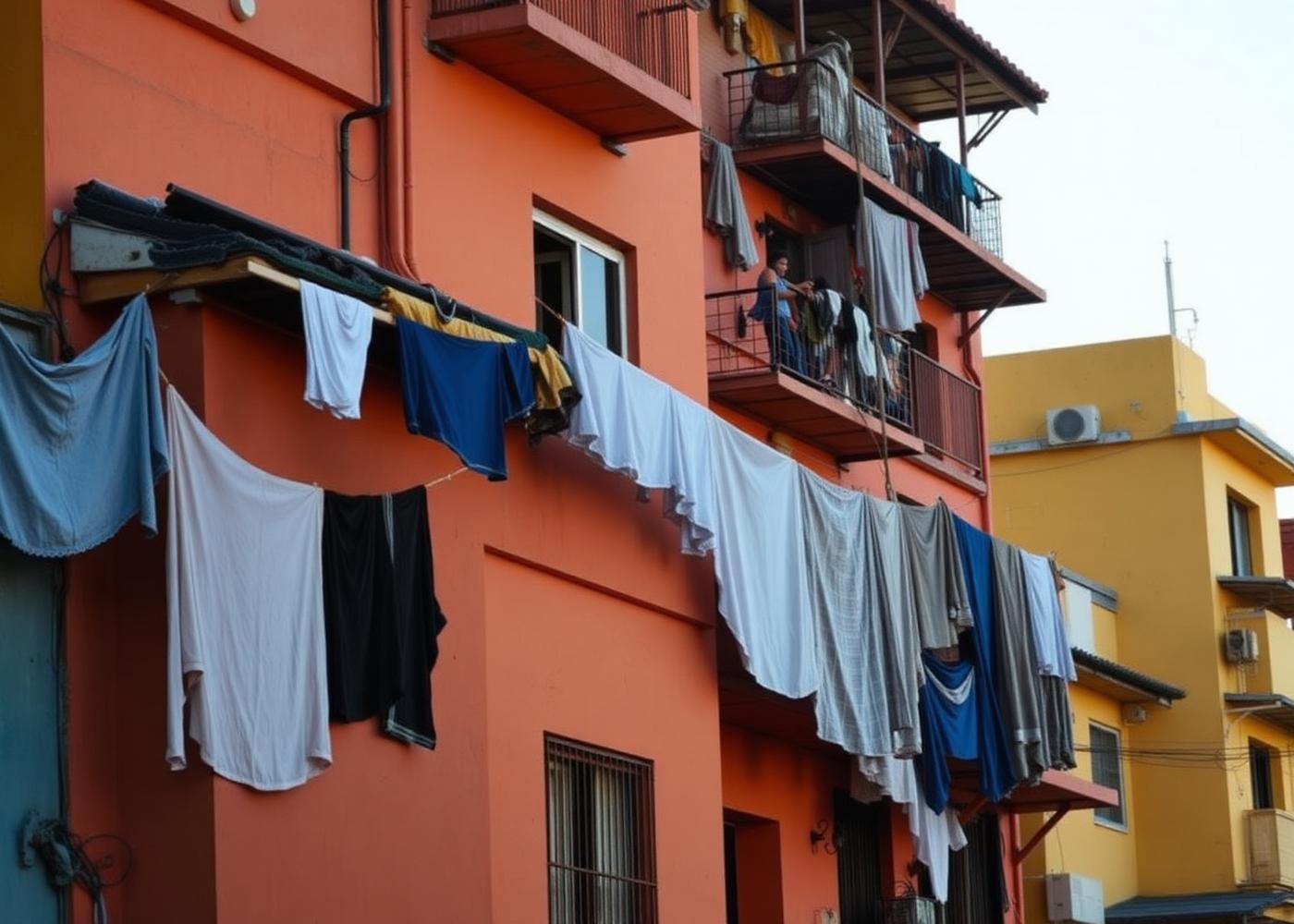
Michael Jackson in Santa Marta
How a music video turned a favela into a world-famous place.
In 1996, Michael Jackson filmed parts of the music video for "They Don't Care About Us" together with director Spike Lee in the community of Santa Marta. The shoot made the community visible worldwide — and its effects are still felt today.
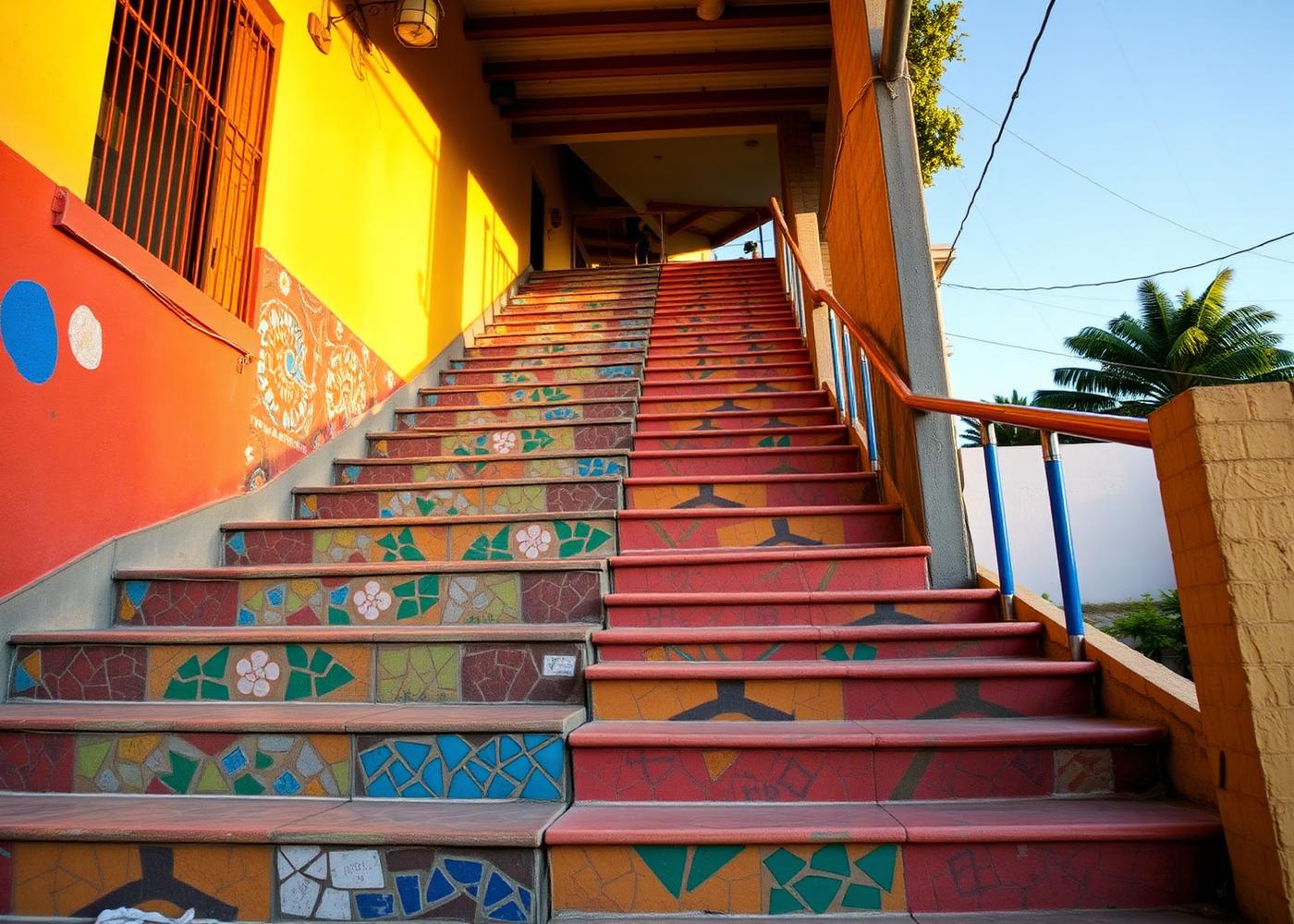
The climb begins at an unremarkable spot in Botafogo. A street, a gate, a staircase — and then it goes steeply uphill. Anyone not taking the funicular counts steps: past façades, past washing lines, past open doors from which television noise and cooking smells drift out. After a few minutes, the view opens up. Below lies the bay, and beyond it Sugarloaf Mountain.
On a concrete platform stands a bronze figure. A man in a hat, right arm raised, the pose unmistakable. Beside it, a colourful mosaic. In front of the statue: a small group of visitors, phones held up, someone imitating the pose, someone laughing. A guide explains something in English. Two children walk past with school backpacks, without looking up. For them, this is not a monument but the way home.
Most people taking photos here know the song. Many know the video. But few know what actually happened in February 1996: that the shoot was politically contested, that authorities tried to prevent it, that the footage was filmed in both Rio and Salvador — and that the statue in front of which they are standing was only erected fourteen years later.
That leaves the question at the very start of it all: why did a global superstar choose this particular hill in Botafogo in 1996?
The Music Video 'They Don't Care About Us'
"They Don't Care About Us" was released in 1995 on the double album "HIStory: Past, Present and Future, Book I" and as a single in 1996. The song is neither a ballad nor a classic pop track, but a protest number: hard, march-like percussion, a chorus that sounds like a crowd, and lyrics about the abuse of power, police violence, racism and the feeling of being abandoned by institutions.
The album itself was a statement. Michael Jackson had just been through what was publicly debated about him in the early 1990s, and he responded with a work that mixed accusation, defence and reflection. "They Don't Care About Us" was the title that pointed most clearly outward — at institutions, structures, systems.
The song was controversial even before the video. Two lines were criticised as antisemitic in 1995. Michael Jackson rejected this reading, explained he had meant to quote, not reproduce, the language of discrimination, apologised for its impact, and had the passages changed in later pressings. This debate is part of the song's history — even though it played almost no role in Brazil.
For the visual realisation, the choice fell on Spike Lee. His films had already addressed racism, police violence and urban inequality. What emerged were two very different video versions: one set in a prison scenario using documentary news footage — and one filmed in Brazil, with people, sunshine, drums and movement.
Why Santa Marta?
Santa Marta lies on the slope of Morro Dona Marta in Botafogo — right in the middle of the Zona Sul, only a few minutes from the metro, within sight of Sugarloaf Mountain and Guanabara Bay. For an international production with a limited time window, this proximity is a tangible advantage: short distances, accessible equipment, plannable logistics.
The second reason is topography. Santa Marta is comparatively narrow and very steep. A central staircase axis runs through the community, with houses stacked on either side. For a camera, this produces something rarely available in flat city districts: multiple image planes. People stand simultaneously above, beside and below the main subject. Every window, every roof, every step becomes a possible stage.
The third reason is the social structure. Even then, Santa Marta was among the communities with an active residents' association and functioning internal forms of organisation. A shoot involving hundreds of participants is impossible without local coordination — someone has to arrange access, inform people, and coordinate.
And finally, there is the thematic dimension: a song about people no one cares about was not meant to be made in a studio. The decision to film in a favela and in the historically Black centre of Salvador was a statement — about the perspective from which the song speaks.
The Filming
The Brazilian shoot took place in February 1996 and was an exceptional situation for everyone involved. An international film crew, security personnel, equipment, press from around the world — and a community where people live, work and go to school. According to consistent reports, the filming in Santa Marta itself lasted only a few hours up to a maximum of two filming days.
Organisationally, this meant paths had to be kept clear, cables laid, power supply arranged and access coordinated — in terrain with no roads for equipment vehicles, only stairs. Everything needed up top had to be carried up by hand. Anyone who has ever been to Santa Marta knows what that means physically.
Numerous residents took part: as extras, as dancers, as people in windows and on rooftops, as onlookers who remained in shot. Reports from the time describe an atmosphere somewhere between a street festival and a state of emergency: dense crowds, children on walls, television crews trying to get near the set.
Percussion was musically dominant. However, the large drum formations in the finished video come from Salvador — see the chapter on Olodum. In Rio, people dominate the space: up the stairs, down the stairs, moving with the rhythm.
On the method: Spike Lee staged less of a choreographed stage show and more of a situation. Michael Jackson moves through real spaces, the camera follows him, and people are not backdrop but surroundings. This is exactly what still sets the Brazilian version apart from most pop videos of the 1990s.
Licensed archive material only (agency or press photos). No AI-generated images pretending to be original footage from the shoot.
Political Controversies
Before a single shot had been filmed, the Brazilian shoot was already a political topic. The dispute centred on a single question: what happens to the country's image when the world's most famous pop star films in a favela?
Representatives from politics and the tourism authority feared damage. At the time, Brazil was courting international investment, visitors and prestige projects — Rio de Janeiro was pursuing Olympic ambitions. Images of poverty, the argument went, would undermine that effort. There were attempts to ban the shoot or impose conditions on it; the matter went to court, which allowed the filming to proceed.
Against this position stood an argument formulated at the time mainly by cultural figures and parts of the press: it is not the images that create the problem, but the conditions themselves. Banning footage does not change living conditions — it only changes what is visible.
A second thread of the debate concerned access to the community. Brazilian media reported at the time on arrangements with local figures who effectively controlled access. These reports have become part of the public debate; no solid documentation is publicly available. We therefore present them as what they are: contemporary reporting, not established fact.
In hindsight, the assessment looks different from how it did in 1996. The feared image disaster never materialised. Instead, the video became, over the decades, one of the most-watched music videos ever — and Santa Marta became a place that people from all over the world deliberately seek out. That said, the debate over who is allowed to take images from favelas, and who benefits from them, is far from over. It resurfaces today with every traveller carrying a smartphone.
„It was not poverty that was meant to be banned, but its image. That was precisely the contradiction at the heart of the 1996 debate."
Spike Lee
In 1996, Spike Lee was not a music video director who happened to land a big job. He was an established filmmaker whose work had, since the 1980s, dealt with racism, class relations and urban reality in the United States. "Do the Right Thing" (1989) dealt with escalation and police violence in a Brooklyn city block, while "Malcolm X" (1992) told the biography of one of the most important figures in Black civil rights history.
These themes made him the obvious choice for a song about exactly that. Lee's visual style — people in dense urban spaces, direct looks into the camera, movement as a means of expression — suited the aim of not just illustrating the song, but locating it.
His collaboration with Michael Jackson's work did not end in 1996. Lee later directed the posthumously released video for "This Is It" (2009) and made two documentaries about Jackson's music: "Bad 25" (2012) and "Michael Jackson's Journey from Motown to Off the Wall" (2016). Both films show an interest that goes beyond pop culture: Lee views Jackson's work as part of Black cultural history.
For Brazil, this meant a particular perspective. Lee did not portray Santa Marta and Pelourinho as a backdrop of misery, but as places with people, rhythm and self-assurance. The residents do not appear as victims in the background, but as the driving force of the movement on screen.
Intended for a licensed portrait photo (agency or press distribution).
Santa Marta in the Music Video
Anyone comparing the video with the place today will recognise almost every shot. The Brazilian version works with a few, clearly distinct visual devices — and draws its power precisely from that.
The staircase as a stage. Santa Marta's central staircase axis structures the image like an amphitheatre. The camera looks either upward, making the crowd appear above the main subject, or downward, creating depth and vanishing lines. Movement in the frame is therefore always vertical — a contrast to the horizontal movement of classic street scenes.
Windows and rooftops. In Santa Marta's built environment, each home sits at its own height. People in the video are therefore everywhere: in window frames, on ledges, on lajes. This creates the impression that the community is not watching, but taking part.
Colours. Instead of the bright saturation of many 1990s videos, earthy tones dominate: plaster, brick, concrete, punctuated by individual strong colour patches on walls and clothing. The visual language feels more documentary than promotional.
Rhythm and editing. The cutting follows the percussion. Because the song's rhythm is march-like, it creates the impression of an unstoppable movement — a demonstration march, not a dance clip.
Lines of sight. People look directly into the camera strikingly often. Visually, this means they are not objects of observation but counterparts. This choice sets the video apart from many later favela images in advertising and film.
Symbolism. The climb from the lower to the upper part of the community — from the narrow to the wide, from the alley to the panorama — is the visual through-line of the Rio scenes. It works as an image for what the song is about: becoming visible.
Video stills only with clearance from rights holders (Sony Music / rights owner). Paired with our own current photography.
The Role of Olodum
The second filming location lies 1,600 kilometres to the north: Pelourinho, the historic centre of Salvador da Bahia. There, in a UNESCO World Heritage site of colonial buildings and cobblestones, the scenes with Olodum were filmed.
Olodum was founded in 1979 and is far more than a percussion group. The organisation combines music with educational work, youth projects and a clear anti-racist self-identity. Its sound — samba-reggae — combines Brazilian percussion traditions with Caribbean influences and is inseparable from the Afro-Brazilian culture of Bahia.
Olodum was already internationally known before 1996, through its collaboration with Paul Simon on his album "The Rhythm of the Saints" (1990). For "They Don't Care About Us", the group provided what carries the video both acoustically and visually: hundreds of drums moving in tight formation, with a precision born of decades of rehearsal.
This distinction is not a minor detail. It concerns the attribution of cultural achievement: the drumming culture of the video is Bahian. Crediting it to Rio erases the origin of a distinct, home-grown Afro-Brazilian tradition. To see how closely music and urban history are intertwined in Rio, read our article "How Samba Was Born in the Morros".
Residents' Reactions
The most common simplification about the shoot is to say "the community" reacted — as if there were a single opinion. Santa Marta has several thousand residents. Assessments varied, and still vary, accordingly.
In the accounts guides and residents share on tours, the dominant memory is of an event that suspended everyday life: the day helicopters circled, strangers with cameras arrived, and the world's press suddenly stood in a community that had otherwise only ever appeared in police reports. This memory is largely positive — a moment of collective visibility.
Alongside it exists a critical reading, just as old: that an international crew took the footage away, that the attention faded again, and that nothing changed about the sewage system, housing or income. This criticism is rarely aimed at Michael Jackson personally — it targets a pattern that communities worldwide recognise: attention as an event, not as change.
A third perspective comes from younger residents who were not yet born in 1996. For them, the viewpoint is part of everyday life and an economic reality: it brings people up the hill who buy, book and pay for things. Whether that is a good thing or a burden depends on how visitors behave.
How the Video Changed Santa Marta
It would be wrong to say the video changed Santa Marta. It is more accurate to say: it changed how people talk about Santa Marta — and that had consequences.
Fame. Before 1996, Santa Marta was practically unknown outside Rio. Afterwards, it was the favela people in Tokyo, Berlin or Chicago could name. That fame was not an end in itself: it created a reference point around which projects, media coverage and tourism later oriented themselves.
Media. Coverage of Santa Marta shifted — away from purely crime-related reporting, toward culture, travel and social themes. That is a remarkable effect, showing how strongly a single popular culture image can shift the narrative around a place.
Tourism. Community tourism did not emerge in Santa Marta in 1996, but in the years that followed — and accelerated after 2008, when the funicular made the climb easier and public perception changed once again. The viewpoint became the destination; the video, the reason to go.
Local economy. Businesses sprang up around the climb: guided tours, small stalls, drinks, crafts, photography. These income opportunities are real, but unevenly distributed and dependent on travel cycles. They do not replace structural improvement.
Pride. Many residents describe the international visibility as a counterweight to a stigma that has followed them all their lives. A place people visit voluntarily is a different place from one people are only warned about.
Criticism. At the same time, where visitors come, questions arise about privacy, photography, prices and distribution. Anyone visiting the place should know they are entering a residential street. More on this in our in-depth community profile Visiting Santa Marta.
The Michael Jackson Statue
The spot where the statue now stands was already significant before: a laje in the upper part of the community with a wide view over Botafogo and the bay. After the shoot, individual fans came here; after Michael Jackson's death in June 2009, considerably more did.
According to consistent reports, the permanent memorial was built in 2010: a bronze statue in the well-known pose, complemented by a colourful mosaic panel on the adjacent wall. The statue is thus explicitly not a relic of the shoot, but a later work of memorial culture — built at a time when Santa Marta stood in the national spotlight as the first UPP community, and community tourism was beginning to take hold.
Today, the viewpoint operates on several levels at once: as a pilgrimage site for fans, as a photo spot, as an economic foundation for guides and small businesses — and as a perfectly ordinary thoroughfare for the people who live there. This simultaneity makes it both interesting and demanding.
Original photography intended. Only depict people with consent.
Can You Visit the Filming Location Today?
Yes. Santa Marta is among the best-connected communities in Rio, and among the most clearly organised for visits. The viewpoint with the statue is publicly accessible and free to enter.
On the slope of Morro Dona Marta in Botafogo, Zona Sul. Access is via Rua São Clemente; the nearest metro station is Botafogo.
On foot from Botafogo, by metro/bus, or by taxi to the foot of the hill. From there, the funicular (Plano Inclinado) runs up via several stations. Operating hours vary — check beforehand.
The laje with the statue and mosaic lies in the upper part. From there, views over Botafogo, the bay and — on a clear day — as far as Sugarloaf Mountain.
Allow one to two hours for the funicular, the viewpoint and a short walk around. Guided tours usually last two to three hours.
We explicitly recommend a companion from the community: more context, more assurance in navigating, and the money stays local.
Panoramas, the statue and the architecture are generally fine. People, homes and interiors only with explicit consent.
Greet quietly, keep paths clear, don't film into open doorways, spend money locally, no drones without prior arrangement, no live location tagging.
Even with the funicular, stairs remain. Sturdy shoes, water, sun protection — and extra care on slippery steps in the rain.
Map: Michael Jackson in Rio and Bahia
The Brazilian footage is spread across two cities. This overview shows the key stops — and a sensible route for a visit to Santa Marta.
| Place | City | Role |
|---|---|---|
| Santa Marta | Rio de Janeiro, Botafogo | Main filming location in Rio Stairs, alleys, rooftops and the upper viewpoint area overlooking Botafogo and Guanabara Bay. |
| Laje do Michael Jackson | Santa Marta, upper hillside area | Present-day memorial site Viewpoint with a bronze statue (2010) and mosaic panel; the central point of interest for visitors. |
| Pelourinho | Salvador da Bahia | Second filming location Historic centre with colonial architecture; where the scenes with Olodum and the large drum formations were filmed. |
| Largo do Pelourinho | Salvador da Bahia | Percussion scenes Cobblestone square overlooking the church of Nossa Senhora do Rosário dos Pretos — a striking backdrop in the video. |
- 1. Start at Rua São Clemente, meeting point with a local guide.
- 2. Ride the Plano Inclinado up; a stop midway offers the first view over Botafogo.
- 3. Praça Cantão — colourfully painted house façades, a well-known community art project.
- 4. Climb up to the Laje do Michael Jackson: statue, mosaic, panorama.
- 5. Return via the stairs, stopping at local businesses and craft stalls along the way.
You can find an interactive map of all of Rio's communities on our favela overview.
5 Things You Probably Didn't Know About the Shoot
- There are two official video versions of the song — the Brazilian one by Spike Lee, and a second one filmed in a prison setting with documentary news footage.
- The shoot went ahead against political resistance: officials tried to stop it, and courts allowed it to proceed.
- Not a single drumbeat by Olodum was filmed in Rio — the percussion scenes were shot entirely in Salvador da Bahia.
- The bronze statue at the viewpoint was only built in 2010, 14 years after the shoot and one year after Michael Jackson's death.
- Santa Marta became the site of Rio's first UPP in 2008 — the international fame from the video played a role in the public debate surrounding it.
Myths and Reality
"Michael Jackson lived in Santa Marta."
He was there exclusively for the filming — a few hours up to a maximum of two filming days in February 1996. He stayed at a hotel in Rio.
"The statue dates from 1996."
According to consistent reports, the bronze statue was only erected in 2010 — over a decade after the shoot and after Michael Jackson's death in 2009.
"Only Santa Marta appears in the video."
The Brazilian version was filmed in Santa Marta (Rio) and in Pelourinho (Salvador da Bahia). There is also a completely different prison version.
"Olodum performed in the favela."
Olodum's scenes were filmed in Salvador. In Santa Marta, local residents took part, not the group from Bahia.
"Michael Jackson made Santa Marta famous."
The community has existed since the 1930s and had a long history, organisation and culture of its own well before then. The video made it internationally visible — it did not create it.
"All residents were thrilled."
Reactions were, and still are, mixed: pride and joy on one side, criticism of appropriation and a lack of subsequent improvement on the other.
"The video solved the community's problems."
Infrastructure, housing conditions and income did not change as a result of the shoot. Later improvements — such as the funicular — resulted from municipal programmes and years of local organisation.
"The government supported the shoot."
On the contrary: parts of the political establishment and the tourism authority tried to prevent it. Only court decisions allowed the filming to go ahead.
"Spike Lee only made this one video with Michael Jackson."
Spike Lee later worked with Michael Jackson's work again: among other things on the video for 'This Is It' (released posthumously in 2009), and with the documentaries 'Bad 25' (2012) and 'Michael Jackson's Journey from Motown to Off the Wall' (2016).
"The viewpoint is officially named Michael Jackson Square."
The common names are 'Laje do Michael Jackson' and 'Espaço Michael Jackson'. It is an organically grown, locally used name for a viewpoint, not an officially designated square.
"You need a permit to enter Santa Marta."
Santa Marta is a residential neighbourhood, not a restricted site. No permit is needed — but respect is, ideally with local company and restraint when taking photographs.
"The balcony scene shows Michael Jackson's apartment."
These are residents' homes, made available for the shoot. For the families there, this remains part of their everyday history to this day — not a film set.
Timeline
- 1930s
The first permanent settlement of Morro Dona Marta in Botafogo. Over the decades, a community with its own structure grows out of makeshift housing.
- 1979
Olodum is founded in Salvador da Bahia — an Afro-Brazilian cultural and percussion group that combines music with educational and anti-racism work.
- 1990
Olodum becomes internationally known: the collaboration with Paul Simon on 'The Rhythm of the Saints' makes the drums of Pelourinho heard worldwide.
- June 1995
Michael Jackson's double album 'HIStory: Past, Present and Future, Book I' is released, featuring 'They Don't Care About Us'.
- January 1996
It becomes known in Brazil that Michael Jackson and Spike Lee intend to film in Rio de Janeiro and Salvador. Politicians, the tourism authority and the media argue fiercely about the country's image.
- February 1996
After a legal tug-of-war, filming takes place: in Santa Marta in Rio de Janeiro and in Pelourinho in Salvador, together with Olodum.
- 1996
'They Don't Care About Us' is released as a single. Spike Lee's Brazilian video version is broadcast worldwide; the prison version is released in parallel.
- 2008
Rio's first UPP (Unidade de Polícia Pacificadora) is set up in Santa Marta — a turning point in the public perception of the community.
- from 2008
The funicular (Plano Inclinado) connects the hillside to the district of Botafogo via several stations, fundamentally changing everyday life on the ascent.
- June 2009
Michael Jackson dies. People gather at the filming location in Santa Marta — the site becomes an informal memorial point.
- 2010
The permanent memorial is built at the viewpoint: a bronze statue of Michael Jackson, complemented by a colourful mosaic panel.
- 2010s
Community tourism becomes established. Local guides, small food businesses, and art and culture projects spring up around the community's best-known viewpoint.
- today
The viewpoint is among the most photographed spots in any favela worldwide — while remaining part of a residential neighbourhood with its own everyday life.
Picture Comparison: 1996 and Today
Much about the place remains recognisable: the staircase axis, the view over the bay, the narrowness of the alleys. What has changed are the details that make the biggest difference in everyday life — power lines, water supply, paved paths, the funicular, and the colourful painting of some façades.
Only with rights clearance from the rights holder. No AI image pretending to be an original photo.
Photographed from the same angle as in the video, with no people in the foreground.
Original photography. People only with consent; no shots into private homes.
Voices from Santa Marta
This section is intentionally left open. We only publish statements that we have collected ourselves or taken from a verifiable source. Conversations are planned with:
We are looking for people who were there in 1996, either as participants or onlookers.
How do they tell the story today — and what do visitors ask most often?
What role does music play in the community beyond the music video?
How does the community organisation assess the handling of tourism at the viewpoint?
Assessment of media coverage and municipal politics in the 1990s.
Were you there in 1996, or do you know someone who was? Write to us at info@insidefavela.com. We document memories with the consent of those involved — and without dramatising them.
Glossary
- Santa Marta
- Community in Botafogo, Zona Sul of Rio de Janeiro, on the slope of Morro Dona Marta.
- Dona Marta
- Name of the hill; often used colloquially — including in media reports from 1996 — as a synonym for the community.
- Laje
- Flat roof or concrete platform on top of a house. In Rio's communities, it serves simultaneously as a social meeting place, laundry area, stage and viewing terrace.
- Laje do Michael Jackson
- Common name for the viewpoint in Santa Marta where the statue and mosaic stand.
- Pelourinho
- Historic centre of Salvador da Bahia, a UNESCO World Heritage site, and the filming location for the Olodum scenes.
- Olodum
- Afro-Brazilian percussion and cultural group founded in 1979 in Salvador.
- Samba-reggae
- A style originating in Bahia that combines samba percussion with reggae rhythms; central to Olodum's sound.
- HIStory
- Michael Jackson's 1995 double album on which 'They Don't Care About Us' was released.
- Plano Inclinado
- Funicular that serves the slope of Santa Marta via several stations.
- UPP
- 'Unidade de Polícia Pacificadora' — a police programme from 2008 onward; the first unit was set up in Santa Marta.
- Zona Sul
- The southern zone of Rio, including Botafogo, Copacabana and Ipanema.
- Morro
- Hill; in Rio, also a widely used term for the communities on the city's hillsides.
- Community
- Self-designation ('comunidade') preferred by many residents over derogatory outside terms.
- Community tourism
- A form of tourism in which planning, guiding and income remain, as far as possible, with the local people.
Frequently Asked Questions
Where was 'They Don't Care About Us' filmed?
The Brazilian version of the music video was shot in two places: in the community of Santa Marta (also called Dona Marta) in the Botafogo district of Rio de Janeiro, and in the historic centre of Pelourinho in Salvador da Bahia. There is also a second, entirely different video version set in a prison, which has nothing to do with Brazil.
When did the filming take place?
The Brazilian footage was shot in February 1996. Michael Jackson was only in the country for a few days; according to consistent media reports from the time, the shoot in Santa Marta itself lasted only a few hours up to a maximum of two filming days.
Who directed the video?
The American filmmaker Spike Lee, known for films such as 'Do the Right Thing' and 'Malcolm X', directed the video. He was responsible for both versions — the Brazilian one and the prison version.
Why did the team choose Santa Marta?
Santa Marta lies in the Zona Sul, is clearly structured by a steep hillside staircase, and offers a wide view over Botafogo and Guanabara Bay. The compact layout, the stairs acting as a natural stage, and the short distance to the city centre made the community attractive both logistically and visually. There was also a thematic dimension: a song about social injustice was meant to be made where inequality in Rio is visible.
Did Michael Jackson make Santa Marta famous?
No — at least not on his own. Santa Marta has existed since the 1930s and had its own residents' organisation, history and culture long before any camera crew arrived. The video, however, gave the community a level of worldwide visibility that no other favela in Rio had experienced in this way.
Did Michael Jackson live in Santa Marta?
No. He was there exclusively for the filming. He stayed at a hotel in Rio de Janeiro. Stories claiming he 'lived in the favela' are among the most widespread legends surrounding the shoot.
Are there two versions of the music video?
Yes. Spike Lee filmed one version in Brazil and a second one set in a prison scenario that incorporates documentary news footage of violence and human rights abuses. Both were released in 1996 and continue to be published in parallel to this day.
Which scenes were filmed in Salvador da Bahia?
The footage featuring the percussion group Olodum was shot in Pelourinho, the historic centre of Salvador. That is where you see the large drum formations, the narrow colonial streets, and the dance scenes involving hundreds of participants. The scenes on stairs, rooftops and narrow alleys overlooking a bay, however, come from Santa Marta in Rio.
Who is Olodum?
Olodum is an Afro-Brazilian cultural and percussion group founded in 1979 in Pelourinho, Salvador da Bahia. It combines music with educational and anti-racism work and was already internationally known through its collaboration with Paul Simon (the album 'The Rhythm of the Saints', 1990).
Did Olodum also perform in Santa Marta?
No. Olodum's appearances in the video were filmed in Salvador. In Santa Marta, local residents were involved. The editing of the finished video makes both locations appear as one continuous setting — that is a filmmaking technique, not geographical fact.
Why was there political criticism of the shoot?
In 1996, parts of the national and municipal government, as well as tourism representatives, feared the footage could portray Brazil internationally as a poor, violent country and damage tourism and the city's Olympic ambitions at the time. There were attempts to ban the shoot; courts ultimately allowed it to go ahead.
How did the residents of Santa Marta react to the filming?
Reactions varied. Many recall pride and excitement, and the fact that the world looked at their community for the first time. Others criticised then, as they do now, that an international crew came, took the footage, and left the structural problems unresolved. Both perspectives exist side by side.
Were residents paid for taking part?
There is no fully documented, publicly available record of fees or contracts. Contemporary reports mention payments to participants and expenditure within the community; we deliberately do not repeat specific figures here, as they cannot be reliably verified.
Where does the Michael Jackson statue stand?
At the viewpoint known as Laje do Michael Jackson — also called 'Espaço Michael Jackson' — above the residential area of Santa Marta, not far from the upper stations of the funicular. A colourful mosaic panel stands right next to it.
Does the statue date from 1996?
No. It was erected many years after the shoot, according to consistent reports in 2010 — that is, after Michael Jackson's death in 2009. The spot had already become an informal gathering place for fans beforehand; the bronze figure turned it into a permanent memorial.
Does visiting the statue cost an entrance fee?
The viewpoint itself is publicly accessible and free to enter. Costs arise from getting there, guided tours, tips and local spending. Anyone visiting the community should spend money locally — that is the most direct way to ensure something stays there.
How do you get to Santa Marta?
The community lies in Botafogo. Access is usually via Rua São Clemente; from there a funicular (Plano Inclinado) runs up the hillside via several stations. The nearest metro station is Botafogo. Operating hours and availability of the funicular change — please check on the day.
Should you visit Santa Marta with a local guide?
Yes, we explicitly recommend it. Local guides know the routes, the current situation and the people. They ensure that visits remain pleasant for both sides — and that some of the money stays in the community.
Is it allowed to take photos in Santa Marta?
Landscapes, views and the statue, generally yes. People, homes, courtyards and everyday situations only with explicit consent. The viewpoint is a photo spot — the community is a place where people live, not a photo subject.
How safe is a visit to Santa Marta?
The situation in Rio's communities can change at short notice, so we make no blanket statement here. Santa Marta is considered one of the best-organised and most accessible communities in the Zona Sul for visitors. Only an up-to-date, on-the-day assessment is reliable — from your accommodation, local guides or contacts on the ground.
How long does a visit take?
Allow one to two hours for the funicular, the viewpoint, the statue and a short walk around. Guided tours often last two to three hours, including conversations, art projects and breaks.
Is the community called Santa Marta or Dona Marta?
Both names are common. The official name, and the one preferred by many residents, is Santa Marta. Strictly speaking, 'Dona Marta' refers to the hill Morro Dona Marta and is often used colloquially as a synonym — including in media reports from 1996.
What does the lyrics of 'They Don't Care About Us' mean?
The song is a protest track about the abuse of power, police violence, racism and the feeling of being abandoned by institutions. Two lines were criticised as antisemitic in 1995; Michael Jackson rejected that interpretation, apologised for the impact, and changed the lines in later pressings.
Which album was the song released on?
On 'HIStory: Past, Present and Future, Book I', released in 1995. 'They Don't Care About Us' was released as a single in 1996.
Was the shoot coordinated with local power structures?
Brazilian media reported at the time on arrangements with local figures who effectively controlled access to the community. These reports are part of the public debate and continue to be assessed differently to this day. No solid documentation is publicly available, so we present these reports as reports — not as established fact.
Did the shoot economically transform Santa Marta?
Indirectly. The international fame was a precondition for community tourism, guides, small food businesses and art projects to later develop. The shoot alone changed neither infrastructure nor income levels — that required years of local organisation and municipal investment.
Did Michael Jackson ever return to Santa Marta?
No. A further visit to the community is not documented. Michael Jackson died in 2009; the memorial was only built afterwards.
Are there other filming locations in Rio de Janeiro?
The Santa Marta footage dominates the video. A few individual shots show views of the city of Rio. Santa Marta remains, and always was, the central filming location in the city.
Can you watch the music video on site?
Not as an official installation. Many guides show individual scenes on a smartphone and explain, at the original location, exactly which shot was filmed where — that is the most striking way to connect the place with the video.
What should you take away from a visit?
That behind a world-famous music video stands a community with its own history. The statue is a reason to climb up — the real story is told by the people who live there.
Conclusion
Michael Jackson did not put Santa Marta on the map. The community had existed long before, with its own history, its own organisation and an everyday life that never depended on a music video. What the 1996 shoot achieved was something different, but no less significant: it made this place visible to millions of people worldwide — in images that did not show residents as backdrop, but as people looking directly into the camera.
The viewpoint high above Botafogo still stands as a reminder of how closely music, culture and a specific place can be intertwined. Anyone who climbs up should see both: the statue — and the community that existed before it and continues to exist once the last tour group has descended.
„A music video can make something visible. Only the people who live there can change a place."
Sources & Further Information
- Author: Lucas Berger
- Expert review: music and culture journalism, local guides from Santa Marta
- Published: 02. Juni 2026
- Last update: 05. August 2026
- Official releases relating to "HIStory" and the single (Sony Music / Epic Records)
- Interviews and statements by Spike Lee on the video work and documentaries
- Contemporary Brazilian and international press coverage from 1996
- Materials and self-representation of Grupo Cultural Olodum, Salvador
- Academic work on music video, representation and urban studies in Rio de Janeiro
- Residents' association and local cultural projects in Santa Marta
- Municipal information on the Plano Inclinado and infrastructure in Botafogo
Where information relies only on contemporary reporting or oral tradition, this is made clear in the text. Factual corrections and input from the community are explicitly welcome: info@insidefavela.com.